

Program Overview
Philosophy
Ask big questions. Build powerful skills. Explore ideas that have shaped human thought while developing the analytical, ethical, and communication skills valued across professions.


Critical Thinking
Develop the analytical and reasoning skills needed to evaluate complex questions and communicate ideas effectively.

Collaborative Community
Join a close-knit intellectual community where conversations continue through weekly Philosophy Roundtable discussions and visiting scholars.

Interdisciplinary Learning
Combine philosophy with another major or minor to explore questions across disciplines and prepare for diverse career paths.
Why study philosophy at Wooster?
.svg)
Join a welcoming community where discussion extends beyond the classroom through the long-standing Philosophy Roundtable.
Study alongside faculty, classmates, and visiting scholars in an environment that values conversation and intellectual curiosity.
Pair philosophy with almost any major, making it easy to pursue interdisciplinary interests within a liberal arts education.
Explore questions that connect philosophy with fields including education, law, medicine, environmental ethics, race and justice, and global philosophical traditions.
Build the critical thinking, writing, and communication skills that prepare graduates for a wide range of professions and graduate programs.


Explore philosophy from many perspectives.
Students may pursue either a major or a minor in philosophy.
The curriculum spans both foundational and contemporary topics, including ethical theory, philosophy of education, philosophy of law, biomedical ethics, environmental ethics, race, gender, and justice, as well as Chinese, Indian, comparative, and other global philosophical traditions.
Many philosophy students pursue a second major, creating interdisciplinary connections across the liberal arts. Students also have opportunities to study abroad and participate in the department's weekly Philosophy Roundtable, where faculty, students, and guest speakers gather to discuss current questions and emerging ideas.

Ready to Explore Philosophy?
If you're curious about the ideas that shape our world and want to develop skills that apply across professions, philosophy offers an excellent foundation for your future.
Career Opportunities
A philosophy degree prepares students for a wide variety of careers and graduate programs.
Wooster philosophy graduates have pursued careers in:
Many graduates also continue their education in law, medicine, and graduate programs across numerous disciplines.
Key Areas

Law
Business
Computer programming
Teaching
Social work
Ministry
Journalism
Publishing
The arts
Public advocacy
Medicine

Elizabeth Schiltz
Professor of Philosophy; Chair of South Asian Studies; Classical Studies
eschiltz@wooster.edu
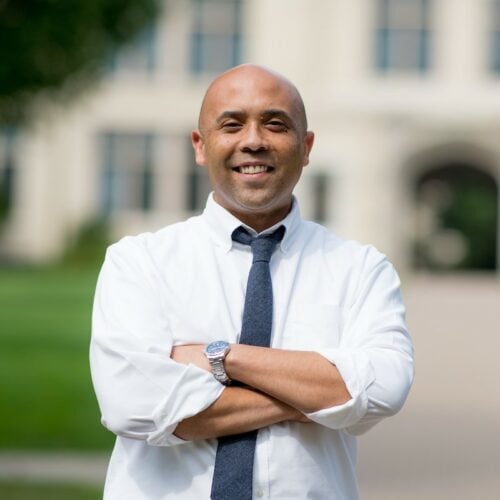
Lee A. McBride
Frank Halliday Ferris Chair of Philosophy; Department Chair of Philosophy
lmcbride@wooster.edu

John Rudisill
Professor of Philosophy, Pre-Law Advisor
jrudisill@wooster.edu

Garrett Thomson
Elias Compton Professor of Philosophy; Middle Eastern & North African Studies
gthomson@wooster.edu

Evan Riley
Associate Professor of Philosophy
eriley@wooster.edu