

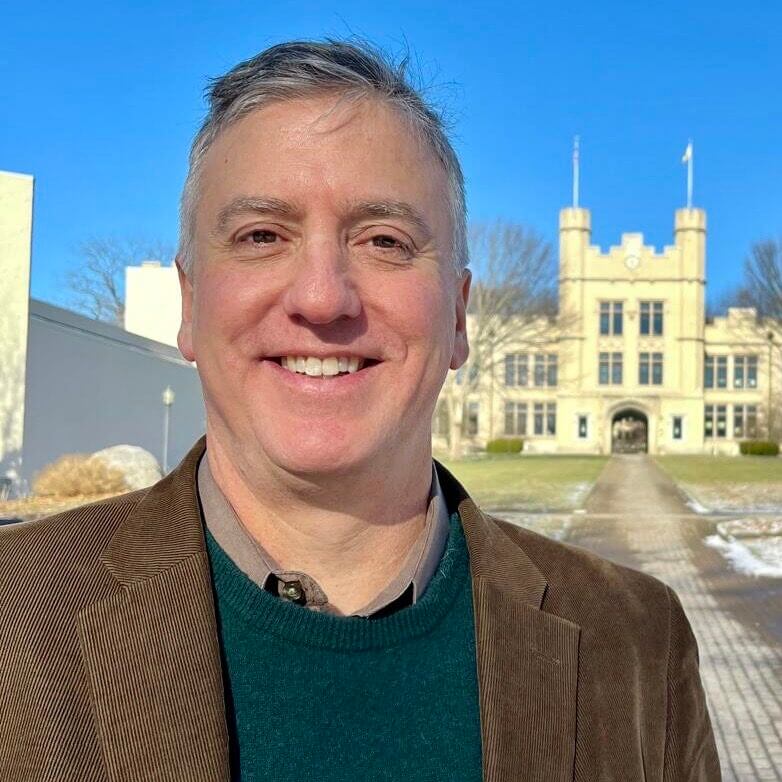
Brian Cope
Associate Professor of Spanish and Raymond and Carolyn Dix Chair of Spanish (On leave 2026-2027)
Biography
Dr. Brian Cope (he/him) joined the faculty in 2005. His scholarship examines the social and philosophical dimensions of literary works and independent films from Spain and Latin America that interrogate the human condition, systemic disparities, and structural inequalities. He is currently completing a book on ancient Greek skepticism in the novels and critical outlook of Spanish novelist Miguel de Unamuno. Concurrently, he is launching a new project exploring the legacy of Italian Neo-Realism in Hispanic cinema. His broader interests—encompassing Iberian and Latin American intellectual history, immigration studies, cultural studies, art, music, and regional social histories—directly inform his course design and teaching at all levels of the curriculum.
An experienced administrator, Dr. Cope served as department chair for seven years. During his 2023–2026 term, he focused on enhancing student engagement and fostering faculty-student community through structured co-curricular activities and an intercollegiate senior research symposium drawing from several consortium schools. He has also contributed to numerous institutional committees, including those focused on global education and academic pathways. Originally from the Central Coast of California with Mexican ancestry (Sonora), Dr. Cope cultivates his lifelong love for Spanish through travel, reading, family, and professional commitments.
Courses Taught
- Beginning Spanish
- Intermediate Spanish
- Readings in Spanish Peninsular Cultures
- Poetic Lives, Poetic Lines: An Introduction to Spanish Poetry
- Hispanic Film (cross-listed with GMDS)
- Cervantes and Don Quijote
- Don Juan in the Spanish Cultural Imaginary (cross-listed with WGSS)
- Fate, Freewill, and Entrapment in Modern Spanish Narrative
- Spanish Existentialist Writers and Filmmakers
- Diversity, Intersectionality, Otherness (FYS)
Teaching Philosophy
I design my courses to take students on a journey of sustained inquiry and discovery that challenges them to continue to grow as Spanish speakers and to practice critical thinking. My courses provide a structured path to their established learning goals, and I support my students by giving them the necessary tools, guidance, motivation, and encouragement to succeed. I believe that learning entails trial and error and that with the right balance of hard work, discipline, and planning everything is attainable.
Selected Publications & Presentations
- “The Rebranding of Don Juan Tenorio as Social Misfit in Tristana,” in Approaches to Teaching Benito Pérez Galdós. New York: MLA, 2026. 64-72.
- “Las raíces filosóficas de la disposición crítica de Unamuno,” in Sendas del hispanismo: márgenes, centros, y convergencia. Actas del XXI Congreso de la Asociación Internacional de Hispanistas (Neuchâtel 2023). Ed. Juan Pedro Sánchez Méndez, Elena Padrón Castilla, and Nerea Parro Gómez. Madrid: Iberoamericana Vervuet, 2026.
- “San Manuel Bueno, mártir as Literary Artifact,” in Approaches to Teaching Miguel de Unamuno. New York: MLA, 2020. 143-152.
- “Atributos escépticos y nietzscheanos de Pachico Zabalbilde de Paz en la guerra de Unamuno” in Perspectivas actuales del hispanismo mundial. Actas del XIX Congreso de la Asociación Internacional de Hispanistas (Munster 2016). Ed. Christoph Strosetzki. Vol. II. Munster: Readbox Unipress, 2019. 173-184.
- “La arquitectura epistemológica de La forma del silencio de María Luisa Puga,” in María Luisa Puga y la (re)construcción del espacio. Mexico City: Editorial de la Universidad Autónoma Metropolitana de México, 2018. 91-116.
- “Unamuno y Montaigne: una aproximación a Niebla desde la Apología a Raimundo Sabunde,” in Hispanismos del mundo: diálogos y debates en (y desde) el Sur. Actas del XVIII Congreso de la Asociación Internacional de Hispanistas (Buenos Aires 2013). Ed. Leonardo Funes. Buenos Aires: Miño y Dávila, 2016. 99-107.
- “Incongruent Visions: Documentary Incursions into the Debate Over Illegal Immigration.” Vanderbilt e-Journal of Luso-Hispanic Studies 8 (Fall 2012): 13-22.
- “Unamuno’s San Manuel Bueno, mártir: Philosophical Skepticism in a Time of Political Upheaval.” Revista de Estudios Hispánicos 45.1 (Spring 2011): 177-199.
- “Synchronicity in Julio Medem’s Los amantes del Círculo Polar: Poeticizing Coincidence in a Taoist Vernacular.” Anales de la Literatura Española Contemporánea 36.1 (Winter 2011): 33-53.
- “The Convergence of Mysticism and Psychosis in Almodóvar’s Hable con ella.” Ojáncano 37 (Spring 2010): 21-40.
- “The Hellenic Origins of Unamuno’s Skepticism and Niebla’s Skeptical Parody of Cartesianism.” Hispanic Review 77.4 (Autumn 2009): 471-493.
Book Reviews
- Newcomb, Robert Patrick. Iberianism and Crisis: Spain and Portugal at the Turn of the Twentieth Century. Toronto: U of Toronto Press, 2018. Hispania 102.4 (December 2019): 624-625.
- Rogers, Gayle. Incomparable Empires: Modernism and the Translation of Spanish and American Literature. New York: Columbia UP, 2016. Hispania 101.4 (December 2018): 653-655.
- Álvarez Castro, Luis. Los espejos del yo: Existencialismo y metaficción en la narrativa de Unamuno. Salamanca: University of Salamanca Press, 2015. Hispania 100.4 (December 2017): 681-682.
- Valle-Inclán, Ramón del. The Memoirs of the Marquis of Bradomín: Spring, Summer, Autumn, and Winter Sonatas. Trans. Robert M. Fedorchek. Intro. John C. Wilcox. Newark: de la Cuesta, 2014. Hispania 99.1 (March 2016): 197-198.
- Montaño Montero, María Luisa. Hacer del abismo fundamento. Reflexiones en torno a la filosofía política de Miguel de Unamuno, Editorial Académica Española Saarbrücken, 2012. Cuadernos sobre Vico 27 (2013): 199-202.
- González-Barreto, Oscar and Ernesto Pierre Silva. Voces y Cine en América Latina: El Caso de Venezuela. Lima: Fondo Editorial Cultura Peruana, 2011. Inti: Revista de literatura hispánica (2012): 73-74.
Independent Study Advising
- “When Music Resists: Nueva Canción Chilena and the Voice of Democracy,” by Evan Amend, spring 2026.
- “De la Transición a la España contemporánea: Una exploración de la representación transgénero en el cine,” by Raine Botello, spring 2026.
- “Effects of Glyphosate Treatment on C. Elegans Health: Implications for Migrant Communities with Elevated Pesticide Exposure,” by J. Payton Timken, spring 2025. [Project contains two chapters on Latinx novels focusing on the theme of pesticide exposure.]
- “Ciclo de la Historia Repetida: El Juego de Espera de los “Dreamers,” by Fernanda Bañuelos, spring 2024. (double major with Education)
- “Joder… Aquí vienen los delinquents. Una exploración de dos películas de Eloy de la Iglesia: Colegas y El pico,” by Hannah Grosman, spring 2023. (double major with Education)
- “Nativism, another word for racism? A study of how anti-immigrant sentiments create animus towards the Latinx Community,” by Elizabeth Suárez, spring 2021. (double major with Political Science)
- “Miguel de Cervantes, Platón, y Francisco de Goya: La conexión entre la fantasía y la realidad,” by Dezmond Morrow, spring 2021.
- “La libertad y sus acontecimientos: un enfoque en el existencialismo y el uso de la
libertad dentro de artefactos culturales,” by Carlos Hernández, spring 2020. (double major with Education) - “Moral Obligations: Towards a Just System of Immigration,” by Mayra López, spring 2019. (double major with Philosophy)
- “Fronteras entretejidas: texto, textil, y la formación de una narrativa mestiza en las obras de Sor Juana Inés de la Cruz, Gloria Anzaldúa, y Sandra Cisneros,” by Claire Billingsley, spring 2016.
- “De monstruo a modelo: Cómo el mito de La Llorona refleja los cambios en la Sociedad, la identidad, y la cultura en tres libros infantiles,” by Charlotte Tierney, spring 2016.
- “Cervantes y Velásquez: Dos artistas revolucionarios y cómo exploraron los mismos conceptos en sus técnicas diferentes,” by Cathryn Rudawsky, spring 2015.
- “Oaxaca vive, ¿la lucha sigue?: Una crónica de conflictividad social,” by Lauren Hines, spring2009. (double major with English)
- “España vista desde afuera: la evolución del turismo en España desde los finales del siglo XIX hasta el nuevo milenio,” by Rebecca Beyer, spring 2007.
- “El concepto de la salvación en las obras de Miguel de Unamuno,” by Emily Richardson, spring 2007.
- “El problema del libre albedrío en Niebla,” by Sean Hennessey, spring 2006.
Professional Affiliations
- Asociación Internacional de Hispanistas
- Modern Language Association
- American Association of Teachers of Spanish and Portuguese
Want to learn more?
Interested in Spanish or have questions about courses? Feel free to reach out!
Contact Brian