

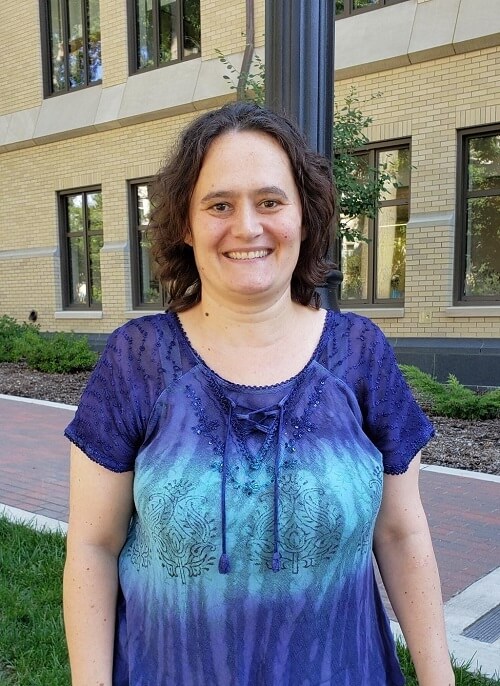
Erzsebet Regan
Whitmore-Williams Associate Professor of Biochemistry and Molecular Biology
Biography
Courses Taught
- BIOL 111:Â Foundations of Biology
- BIOL 201:Â Gateway to Molecular & Cellular Biology
- BIOL 305: Â Cell Physiology
- BIOL345:Â Computational Biology and Lab
- IDPT: FYS
- IDPT20013: Bioinformatics
Selected Publications & Presentations
- *Emmalee Sullivan, *Marlayna Harris, *Arnav Bhatnagar, *Eric Guberman, *Ian Zonfa, E. Ravasz Regan, Boolean modeling of mechanosensitive epithelial to mesenchymal transition and its reversal, iScience 26(4), 2023.
- B. Zakirov , G. Charalambous , R. Thuret , I. M. Aspalter , K. Van-Vuuren , T. Mead, K. Harrington , E. Ravasz Regan, S. P. Herbert, K. Bentley, Active perception during angiogenesis: filopodia speed up Notch selection of tip cells in silico and in vivo, Phil. Trans. R. Soc. B, 376: 20190753, 2021.
- *E. Guberman, *H. Sherief, E. Ravasz Regan, Boolean model of anchorage dependence and contact inhibition points to coordinated inhibition but semi-independent induction of proliferation and migration, Computational and Structural Biotechnology Journal 18, 2145-2165, 2020.
- E. Ravasz Regan, Stochastic phenotypic switching in endothelial cell heterogeneity. In: Levine H (ed). Phenotypic Switching: Implications in Biology and Medicine; Academic Press; 2020, 0128179961 (ISBN-13: 978-0-128-17996-3).
- D. Deritei , J. Rozum , E. Ravasz Regan, R Albert, A feedback loop of conditionally stable circuits drives the cell cycle from checkpoint to checkpoint, Scientific Reports, 9: 16430, 2019.
Independent Study Advising
The central goal of my research program is to uncover the principles of coordination between cellular phenotypes at multiple scales of organization, and build predictive models of this coordination in health and disease. To this end, I pursue four complementary lines of inquiry:
- Computational modeling of coupled biological circuits, each of which drive small-scale phenotypic switches. The goal is to predict the emergent, complex coordination of biological phenotypes. This work focuses on a) modeling regulatory networks that drive cellular life and death processes, and their breakdown in cancer, and b) modeling mammalian stem cell states and their crosstalk with the cell cycle. Several generations of College of Wooster Independent Study students have been involved in this effort, and their work is showcased here!
- Development of theoretical measures, computational tools, and visualization techniques to aid dy- namical modeling of multi-scale, hierarchically organized phenotypes (difficult for most biology/ BCMB IS students; but potential collaborative opportunity for physics majors).
- Developing a predictive, dynamic computational model of the epigenetic state of individual gene promoters (pursued by an NIH-funded Postdoctoral Fellow &Â IS students)
- Measuring, modeling, and predicting the behavior of noise driven mosaic heterogeneity of the endothelium in vitro and in vivo (NIH-funded collaboration with William Aird at the BIDMC).
- Featured in a video about the 25th Krakow Conference on Endothelium: https://www.youtube.com/watch?v=v_RY-lr55eE
Awards & Honors
Henry Luce III Fund for Distinguished Scholarship: Tug of war between healing and aging â modeling the role of migratory cell states and senescence in tissue homeostasis
Hamburger Endowment for Collaborative Projects and Program Development Grant: Can the collective behavior of robots help us understand blood vessel formation?
Henry Luce III Fund for Distinguished Scholarship: Cell collectives in space and time â modeling the coordinated behavior of endothelial cells in response to their physical environment
Want to learn more?
Interested in Biochemistry and Molecular Biology or have questions about courses? Feel free to reach out!
Contact Erzsebet