

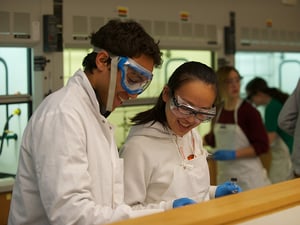
Jennifer Faust and Sara Martin, associate professors of chemistry at The College of Wooster, were awarded a $70,000 grant from the American Chemical Society’s Committee on The Petroleum Research Fund.
The grant will support 17 student positions in Faust’s and Martin’s labs at Wooster over the three-year grant period, as well as provide funds for new equipment and for student travel to regional and national conferences to present their research.
Faust said the award is intended to provide seed money for faculty to explore new research directions. She and Martin, alongside their students, will study how naphthenic acids, a large family of naturally occurring compounds found in crude oil, move through the environment.
 “Even though they are present in relatively small amounts,” said Martin (at left), “they can create major problems during oil production and refining, contributing to corrosion of pipelines and equipment, and forming deposits that clog industrial systems and affect how oil and water separate during processing.”
Scientists don’t yet fully understand how the structures of individual naphthenic acids influence their behavior. The ACS grant will allow Faust’s and Martin’s labs to expand their research into this new class of chemical contaminants.
“We’re studying naphthenic acids one molecule at a time,” said Martin. “Rather than examining the complex mixtures found in crude oil, we are creating and testing carefully selected compounds whose structures differ in specific ways. By comparing them, we can determine how features, such as molecular size and shape, affect whether these compounds stay in oil, move into water, or form unwanted deposits.”
 Faust (at left) added that the project will make use of some of the same experimental techniques her lab has been using to study the properties of PFAS (per- and polyfluoroalkyl substances, also known as “forever chemicals”). “I am excited to create new opportunities for Wooster students to work on funded research projects at the intersection of analytical, environmental, and organic chemistry,” Faust said.
Martin added, “The project will fill important gaps in our understanding of a class of molecules that plays a significant role in petroleum chemistry and provide hands-on research opportunities for undergraduate students, allowing them to contribute directly to new scientific discoveries.”
The American Chemical Society supports scientific education and fundamental research in chemistry, the earth sciences, chemical and petroleum engineering, and in related fields such as polymers and materials science.