

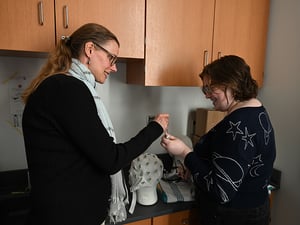
Hannah Reinicke ’26 participated in vocal music ensembles throughout high school and was adamant to continue performing at The College of Wooster. On campus, she joined the Wooster Chorus, Jazz Combo, and the Contemporary Chamber Ensemble, and she sang a cappella with The Dukes and COWBelles. While music was a big part of her life, she never considered majoring in that subject. She had always planned to study psychology, but Wooster’s introductory music theory classes influenced her to pursue both paths.
For Reinicke, two majors included two senior Independent Study projects, and she harmonized her two passions within both projects. First, her psychology project investigated whether there was a difference between how musicians and non-musicians process music and language.
Reinicke drew inspiration from existing studies — one in 1998 and another in 2019 — that found musicians have neurologic reactions to musical chord progressions where one chord doesn’t align with other chords. “You could think of it as a grammatically incorrect chord,” explained Reinicke. “It sounds wrong in the same way that a grammatically incorrect sentence sounds wrong.”
To replicate and expand on these findings with non-musician reactions, Reinicke recruited 34 college students to conduct her own testing. She selected the Goldsmiths Musical Sophistication Index and the Musical Ear Test as quantitative methods to determine musicianship and created musician and non-musician participant groups.
In Wooster’s EEG Lab, each participant then completed electroencephalogram testing wearing a 32-sensor gel cap with electrodes that measured brain electrical activity while listening to musical and language stimuli. Reinicke explained that their responses are called event-related potentials. When participants heard grammatical errors, they were expected to have a specific ERP showing a peak in the waveform around 600 milliseconds after the error. This specific ERP is called a P600.
According to Reinicke’s mentor, Grit Herzmann, associate professor of psychology, the comparison between language (something everyone is good at) and music (something only musicians are good at) could explain more about musical capabilities that are not trained but maybe innate. “The stimulus material is very complex and includes full sentences and melodies,” said Herzmann. “Hannah contacted the original author from the 1998 paper who shared their stimulus materials. This is a great show of collaborative work within science and provides a direct insight into how people work with each other.”
Reinicke initially hypothesized both groups would have the same ERP responses to language stimuli, but musicians would exhibit a different response to music stimuli than non-musicians. She found that behaviorally, both groups performed the same during the language condition, and the musician group did outperform non-musicians in identifying wrong chords. However, both groups exhibited similar P600 responses during all ungrammatical stimuli conditions. “The lack of significant differences between ERPs during ungrammatical conditions could illustrate some music and language processing similarities between musicians and non-musicians,” said Reinicke, noting that the study might need more participants for statistical significance.
She will continue her research in hopes of publication and emphasized that future studies could also look at other paradigms of music. Her research covers Western tonal music through an Americanized perspective, but “Certain styles of Indian music have a different tuning system, for example, so harmony might sound different to someone used to that system,” said Reinicke.
Thanks to conference funding from the psychology department and Advising, Planning, and Experiential Learning (APEX), Reinicke traveled to Vancouver in March for the Cognitive Neuroscience Society Annual Meeting to present her findings and network with other industry professionals. The following month she was back on campus performing her senior recital. To mirror her psychology study, Reinicke’s first half of the program presented standard classical repertoire before contrasting it with contemporary popular music in the second half. “Both sets contrasted the expected and unexpected harmonically and structurally within the songs and within sets of songs,” she said. “I played with ideas like the jazz standard and ‘normal’ jazz progressions and contrasted it with other popular music like that of Björk, which sounds a little more unusual.” The performance also included the entire Wooster Jazz Combo and a few other friends, all under the mentorship of Adam Ewing, assistant professor of music.
Much like the chords in her study, Reinicke described a natural progression of skills and preparation she received throughout her four years at Wooster. From her First- Year Seminar professor who provided key resources, to learning how to look at music in certain ways in music theory classes, to a junior I.S. that doubled as a writing intensive, Reinicke emphasized how she feels very equipped for the future.
“Outside of important research skills, I also built interpersonal skills, especially with the mentor-mentee relationship,” she said. Herzmann saw Reinicke grow as a scholar as well, adding that “This project goes beyond what is required for I.S., as Hannah showed a strong intrinsic drive and awesome time management.”
Before junior year, Reinicke didn’t even realize music cognition was a viable field of study, but now she’s eager to continue this interdisciplinary work and pursue a Ph.D. in cognitive neuroscience with specialization in music cognition. “I want to look into why music affects us the way it does,” she said. “It involves so many parts of our brain, and it’s critical to so many aspects of who we are.”