

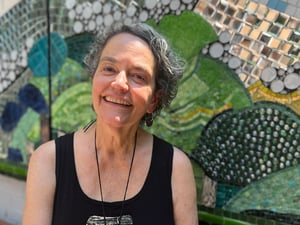
Susan Stair ’76 is no stranger to The College of Wooster. Her father, William Alrich ’39, was also a Wooster alumnus. Originally from Philadelphia, Stair initially planned to major in political science when she first arrived on campus. But after a fellow Wooster student introduced her to studio art, she never looked back. In the spring, Stair returned to campus to complete an artist residency and develop her upcoming fall 2026 exhibition at the College of Wooster Art Museum.
Stair emphasized the flexibility and fluidity of Wooster’s liberal arts curriculum that allowed her to explore different academic fields and ultimately change her major to studio art. “I never thought I’d be making that change,” she said.
With almost no previous studio art experience, Stair worked hard to catch up to her peers. She credits her studio art professors at Wooster with supporting her growth as an artist and her transition to majoring in art. “When I came in saying I wanted to be an art major with zero background, they were very kind,” Stair said. Never having expected to major in studio art, Stair went on to work as a Harlem-based freelance artist.
While attending Wooster, Stair became deeply involved with the Wayne Center for the Arts, a local non-profit arts organization, giving her experience in the field that helped prepare her for her career. “I worked there for two or three years, discovered grant writing, taught art with different groups in town, and developed my interest in public art,” she said.
After earning a Master of Fine Arts in printmaking in 1981 from the University of Delaware, Stair continued to make and exhibit artwork in New York and across Asia, where she lived for 10 years with her husband, fellow Wooster alumnus Bailis Stair ’75. Following her return to New York City after living abroad, Stair spent over 20 years teaching art in at-risk schools for Studio in a School, a non-profit organization.
As a freelance artist based in Harlem, Stair’s work centers around nature, specifically trees. Her interest in nature stems from her childhood. “My father loved trees, and nothing was ever cut down. I spent all my time outdoors growing up, and I loved it,” she said. Stair began to draw trees and started learning more about them from a scientific perspective. She discovered how trees protect biodiversity, support ecosystems, and produce oxygen. “I realized how little people knew or saw trees and how little I knew about them,” she emphasized. “I started to research them, and I was blown away.”
Stair explores the complexity and delicacy of nature by telling its stories. For her, trees and people are completely interdependent. Many of her works are public art installations, allowing Stair to engage with local communities. “Nature has a great deal of power that we’re just discovering. Trees are critical and fundamental; the more I learn about them the more astounded I am.”
Informed by intensive research and reading on biology and climate studies, Stair directly engages with nature as part of her artistic process. Drawing on her background in printmaking, Stair makes clay imprints of trees and bark patterns. These clay pressings are incorporated into collages, mosaics, and assemblages. Through these mixed media techniques, she engages with themes of climate change solutions, biology, and damaged ecosystems.
After receiving a call from Marianne Wardle, director and curator of CWAM, Stair leapt at the opportunity to return to campus to complete a residency at the college at the end of spring 2026. In advance of her upcoming fall show, Stair spent time working with studio art students and Daren Kendall, associate professor of art and art history. “I was really impressed with the quality of the students and faculty, and the way they worked together,” she remarked. Stair also continued working with clay and printmaking, making pressings of trees across campus to incorporate into her work. Community, nature, and climate change continue to be central themes in Stair’s work. Her upcoming exhibition at CWAM, Radically Rooted, opened on Sept. 8. Stair will return to campus for a reception and curator and artist's talk, where she will discuss the themes and artwork of Radically Rooted. The event will take place at 4 p.m. on Tuesday, Sept. 22, 2026, at Ebert Art Center (1220 Beall Avenue).