

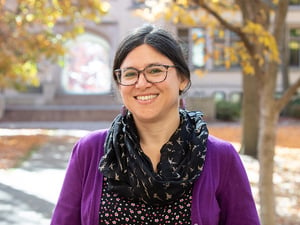
Metropolitan State University of Denver selected Olivia Navarro-Farr, professor of archaeology, sociology, and anthropology at The College of Wooster, for the Richard T. and Virginia M. Castro Distinguished Visiting Professorship. During Wooster’s fall break, Navarro-Farr will travel to Denver to engage with students, faculty, and staff and share her research on the ancestral Maya and royal Maya women.
The Richard T. and Virginia M. Castro Distinguished Visiting Professorship was established in 1997 to foster multiculturalism, diversity, and academic excellence at Metropolitan State University of Denver. The professorship brings renowned Latinx scholars, artists, and leaders of distinction to Metropolitan State University of Denver to conduct classes, seminars, performances, and lectures for students, faculty, staff, and the larger Denver community.
Navarro-Farr’s keynote speech, held on Oct. 8, 2026, is titled Lo Que La Tierra Recuerda: Memory, Regeneration, and Ancestral Knowledge. In this talk, she will discuss “what the Earth remembers” and how ancestral wisdom can move people towards healing and renewal today. She will also visit classes in Metropolitan State University of Denver’s Department of Chicana/o Studies and engage with Latinx campus and community groups about her research on the Maya civilization. Navarro-Farr will return to Denver in the spring for a community panel celebrating the opening of the exhibition Maya Women Across Time at the Denver Art Museum.
Navarro-Farr’s research focuses on ancient Mesoamerica. She has worked in the Maya area since 1997 on archaeological projects in Belize, Mexico, and Guatemala, and she has served as director of the Proyecto Arqueológico Waka’ (PAW) with David Del Cid of San Carlos University of Guatemala and Damien Marken of The Commonwealth University of Pennsylvania since 2017. She has published in various academic archaeology and anthropology journals, including Latin American Antiquity, Feminist Anthropology, and Ancient Mesoamerica, and she has numerous chapters in various edited volumes. Navarro-Farr’s interests include the archaeology of ritual, monumental architecture, site abandonment processes, and the role of royal women in Classic Maya statecraft.
For Navarro-Farr, receiving this honor is a way to take her research on ancient Mesoamerica and use it to connect to and serve the Latinx community. “I’m in love with my research, and my identity as a Mexican American has always informed my scholarship and my approach to teaching,” Navarro-Farr said. “This opportunity allows me to take my work and use it to serve my community. I want to connect my research to people’s lives and create a through-line that helps folks feel a connection to these ancestral Maya women, and the women today who continue to be extremely powerful movers in their communities.”