

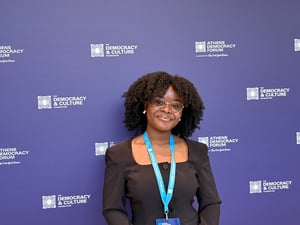
This past September, Willona Asare Ayesu ’28, a political science major at The College of Wooster, traveled to Greece to attend the 2026 Athens Democracy Forum, a conference hosted by the nonprofit Democracy and Culture Foundation in association with The New York Times. The annual forum brings together journalists, politicians, activists, business leaders, scholars, authors, and undergraduates from across the globe to discuss the most critical issues facing democracy and to elevate civic engagement and governance. This year’s event, which took place Sept. 29–Oct. 1, focused on the question “Why democracy, and how must it evolve to be fit for purpose in the 21st century?”
“It was an amazing experience overall,” Ayesu said. “There were so many different perspectives from all over the world, and I learned so much that I never knew.” Ayesu first learned of the opportunity last spring, when former Associate Dean for Experiential Learning and Dean for Faculty Development Sarah Sobek notified Ayesu that she’d been nominated to attend the forum. The application process required her to write two essays: one on whether democracy is declining or being sustained worldwide, and another on her personal experience of democracy. For the second, she wrote about protests in her home country of Ghana over illegal gold mining that was destroying forests, polluting drinking water, and threatening the cocoa farms central to the country’s economy.
Ayesu attended with support from the Great Lakes Colleges Association (GLCA), of which Wooster is a member. GLCA manages the Global Liberal Arts Alliance (GLAA), an education partner of the forum alongside Deree – The American College of Greece. Ayesu was one of 22 GLCA/GLAA students selected to attend. Other student participants at the forum represented countries such as Switzerland, Tanzania, Nepal, Pakistan, Brazil, Ecuador, and Japan. The organizers invited undergraduates, Ayesu explained, because the forum’s speakers and attendees tended to be seasoned professionals and veteran leaders from the United States and Europe. “I think they wanted to know what the younger generation is thinking about democracy,” she shared, “and to get more perspectives from Asia, Africa, and Latin America.”
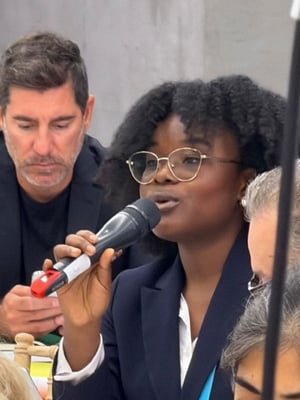 The students arrived two days early to prepare, discussing what democracy means to them and evaluating how accurately global democracy indices measure freedom of the press and freedom of speech. They also explored nearby ruins, ancient theaters, and the Parthenon on the Acropolis. “It was really cool discussing democracy in the birthplace of democracy,” Ayesu reflected. Their tour, she added, reinforced a theme they’d later explore during the forum: Athenian democracy looked very different from today’s systems. “That alone is proof that democracy can exist in different forms in different places,” she explained.
During the first two days of the conference, the student representatives were invited to attend talks and question panelists during the forum’s sessions. Ayesu was also assigned to a special session on rebuilding resilient democracies and rethinking governance. On the second day, she helped draft a report on the session, which included Nobel Peace Prize laureate Tawakkol Karman and Thai political leader Pita Limjaroenrat. During that discussion, Ayesu said, she was struck by the observation that “bad governance cannot take place unless the people allow it” and that “the turning point against autocracy or dictatorship is when citizens decide to unite, protest, and make change.”
On the final day, Ayesu networked with students and speakers. She was especially excited when a Nigerian panelist recognized her from a video she had made prior to the forum on her special session’s topic. The short focused on Ghana and the importance of holding leaders and citizens alike accountable. Knowing that her video caught a professional’s attention, Ayesu said, gave her a sense of validation.
For Ayesu, the forum’s biggest takeaway was to “always seek different perspectives.” She noted that U.S. decisions came up repeatedly in sessions about democracy elsewhere. “You never know how much one decision can affect different people outside of your country,” she said. Another important lesson, she added, was “the importance of participating in democracy” — especially in an era when, as she learned from forum organizer Anthony Kefalas, “most of our problems in democracy stem from insecurity and a lack of trust in our institutions to protect us and fight for us.”
Now back at Wooster, Ayesu, who works as a voter engagement intern, plans to apply what she learned in her outreach to fellow students. She hopes to combine the forum’s lessons with her love of content creation by interviewing students about what an ideal democracy looks like to them. She hopes the video will encourage her fellow Fighting Scots to get civically involved. “Making sure you’re participating,” she added, “is a way of reclaiming your power.”
Featured photo provided by subject. Photo of Ayesu participating in the forum provided by Sofia Stefanova Mihaylova, student at the American University of Paris.