

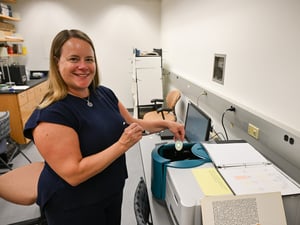
Sarah Sobeck, professor of chemistry and dean for faculty development at The College of Wooster, presented at the fall meeting of the American Chemical Society (ACS) on her work in photochemistry of pigments in art and fashion, held Aug. 23-27. Tying chemistry research to its applications in art conservation, Sobeck’s research offers interdisciplinary collaboration opportunities for Wooster students.
Ongoing studies from Sobeck and her collaborators were featured in a symposium on the “Chemistry Behind Art and Art Conservation” at the conference. Sobeck’s presentation showcased their exploration of why fluorescent and phosphorescent pigments sometimes fade faster than other pigments and colorants within artwork due to their chemical properties. Their research, funded in part by Wooster’s Hamburger Endowment for Collaborative Projects and Program Development, explores both how these pigments can be better preserved and the role of environmental factors like light or humidity on their luminescence. The implications of fading light-emitting pigments encompass both practicalities, like the need for airport runways and phosphorescent signage to stay bright and visible, and the more aesthetic desire to enjoy and understand art the way the artist saw it and intended for it to be seen.
“For artists, the effect isn’t simply cosmetic, because they intentionally use these colors for their visual impact,” said Sobeck.
The research presented at ACS stems from Sobeck’s collaboration with Gregory Smith, senior conservation scientist at the Indianapolis Museum of Art at Newfields. They began working together to test these materials due to their prominence in the Stephen Sprouse collection at the museum, which was featured in a 2023 exhibition Stephen Sprouse: Rock | Art | Fashion.
In the lab, Sobeck and her collaborators examined the chemical components of light-emitting pigments. They’d then study how they absorb, store, and emit light, taking measurements over time as the materials age. Their work included evaluating the chemical makeup of each substance, including inorganic compounds and mineral-based pigments that differed substantially from the organic dyes used in many other colorants. After identifying the components of a given pigment, they experimented to determine what factors dim the brightness and richness of the colors: they found that time, humidity, and exposure to light all impact the level of fading.
The depth and interdisciplinary nature of Sobeck’s research allows Wooster students to collaborate and contribute studies to the wider project. Eleanor Fleming ’27, majoring chemistry and minoring in art history, will investigate a white pigment powder called lithopone for her senior Independent Study research project this fall to determine how sample preparation and relative humidity impact lithopone’s glow after being charged by light. She sees her undergraduate research with Sobeck positioning her for opportunities after graduation, whether she ultimately chooses to work in industry formulating specialty colorants or in an art conservation context.
“Dr. Sobeck has taught me laboratory skills, as well as writing skills to be able to write at a professional level; I’ve been able to take many of these skills to my internship this summer at Sherwin-Williams,” said Fleming. "So many people love both art and science, but they don’t know that these opportunities exist; people who worked with Dr. Sobeck have gone on to very cool careers.”
Georgia Hopps-Weber ’21, who also worked in Sobeck’s lab and studied art history and chemistry at Wooster, now applies her experience as the conservation lab coordinator at the Cleveland Museum of Art, bringing the broad perspective of her dual majors into her daily work.
“I’ve been able to establish a lot of different opportunities for students who are pursuing majors in art history and chemistry or chemistry students who are really interested in seeing how they can apply their studies to different real-world scenarios,” said Sobeck. “It shows how chemistry and art can come together to answer important questions.”