“My grandparents were all immigrant Jews from the “Pale of Settlement,” meaning those provinces of Tsarist Russia where Jews were allowed to reside. My mother’s parents came as young children and were quite Americanized, both high school graduates who spoke English without an accent. My dad’s parents, however, came as teenagers and were far less acculturated. My dad grew up speaking Yiddish at home, and when we gathered weekly at Bobie (grandmother) and Zaydie’s (grandfather) house with the aunts and uncles and cousins and neighbors, the adult conversation was all in Yiddish while we grandkids played and didn’t understand.
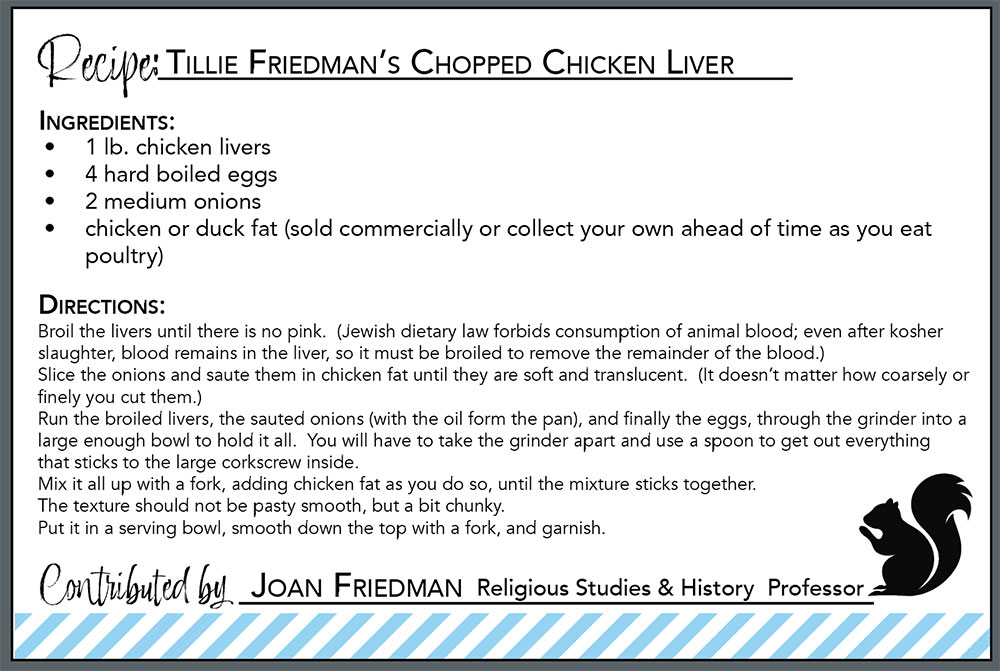
My mother had never learned to make the foods from the “old country,” and didn’t like them, so my dad used to stop off at Bobie and Zaydie’s house once a week on his way home from work, and Bobie would give him a “care package” of the delicacies he loved: kishke (stuffed cow’s intestine), helzel (a sort of dumpling made with the skin from a chicken’s neck), gefilte fish (fish skin stuffed with a chopped fish mixture), mohn (poppyseed) cookies, mandelbrot (similar to biscotti), and my personal favorite, gehakte leber (chopped liver). Chopped liver was also a staple of all festive meals – not only all the Jewish holidays, but also Thanksgiving! And my favorite lunch to take to school during the week of Passover was chopped liver on matzah.
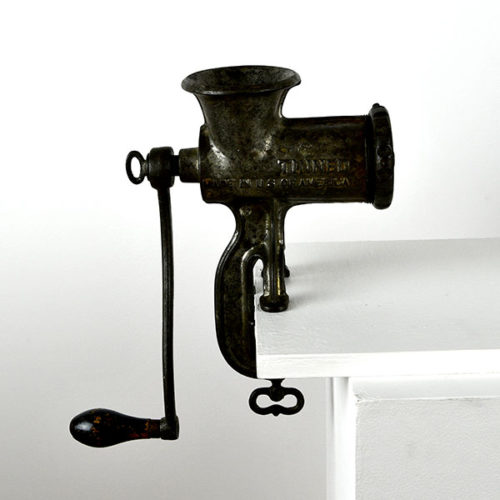
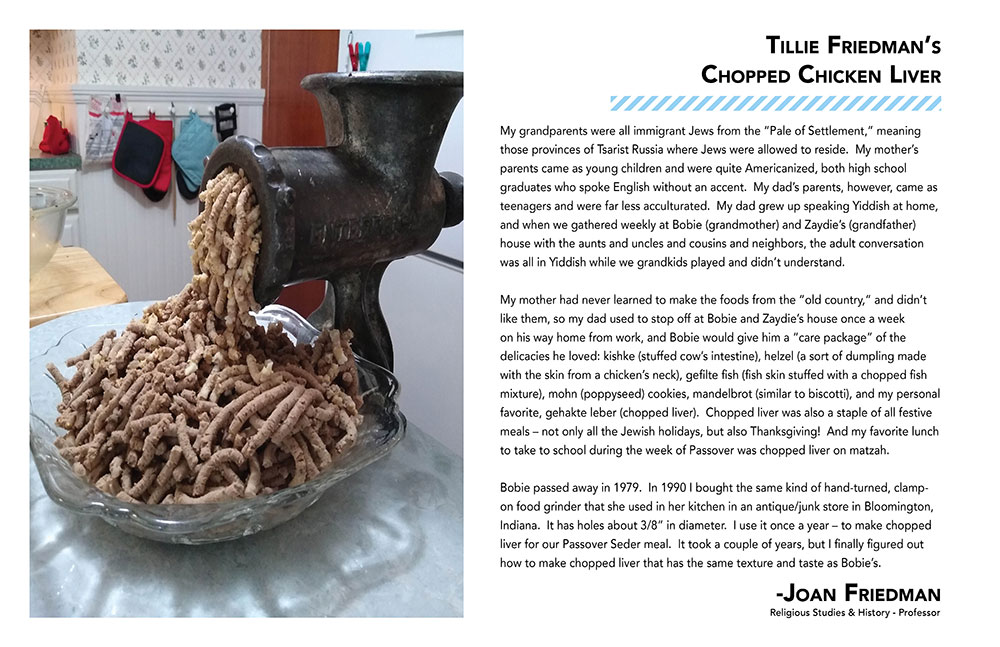
Bobie passed away in 1979. In 1990 I bought the same kind of hand turned, clamp-on food grinder that she used in her kitchen in an antique/junk store in Bloomington, Indiana. It has holes about 3/8″ in diameter. I use it once a year – to make chopped liver for our Passover Seder meal. It took a couple of years, but I finally figured out how to make chopped liver that has the same texture and taste as Bobie’s.”
-Joan Friedman-
Religious Studies & History – Professor