

Geology professor uses her undergraduate training as an engineer to bring new insights to field
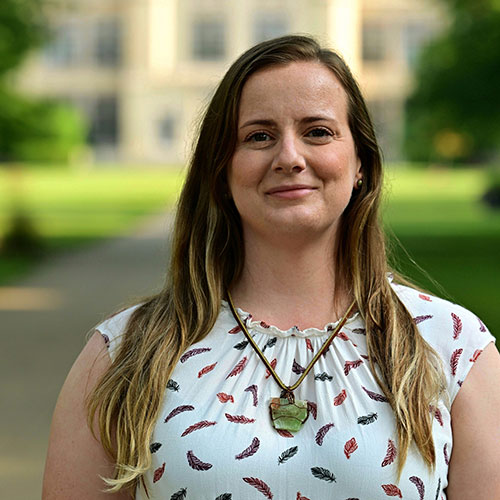
Stephanie Sparks, visiting assistant professor of geology at The College of Wooster recently published a paper that outlines a method for applying sensitivity analysis to geologic calculations. The study in Geochronology, Thermochronology and Time Scale Research could provide a way to measure the degree of uncertainty in research about heat flow in the Earth’s crust.
After studying material science and chemical engineering as an undergraduate, with the goal of doing polymer research, Sparks developed an interest in geology in her early work career, as she saw how one field connected to another. Over geologic time spans, “the lithosphere flows in the same way a polymer might,” she said, using the professional term for the rigid outer part of the Earth.
From her engineering background, she realized that existing geologic calculations could be made more precise. “To me, a number without an uncertainty attached is incomplete,” she said. However, Sparks says that geology research is often published without those calculations of uncertainty or with such a wide range that the number might not be useful at all. “You’re not making interpretations based on reality or on the conditions of the model you set up,” she said. “It’s not very telling.”
That realization led her to apply the Taguchi method, a statistical analysis tool common in engineering but relatively new to geology. “I know I can make this more efficient,” she said. “I learned this in engineering; let’s see if we can apply it to geoscience.”
Assigning a number to the uncertainty of a particular data set “is not out of reach for us,” she said. “Lots of people don’t do sensitivity analysis or put it in a publication. The motivation is to get more people to implement this more widely.”

Sparks completes field research in Nepal.
Approaching data with an understanding of its limits is a method she teaches Wooster students. “It’s a passion of mine to have transparency about what we know,” she said. “Maybe I don’t know everything about a particular subject, but I can tell you what I do know and where to find more information.” Her students learn about the strengths and limitations of given data sets and about the repercussions of making assumptions.
“Sparks’ research demonstrates the cutting-edge, interdisciplinary approach our earth sciences program takes,” said Meagen Pollock, Lewis M. and Marian Senter Nixon Professorship in the Natural Sciences. “Students here learn not just traditional geology, but also advanced computational methods borrowed from engineering. Her cross-disciplinary skill set helps our graduates succeed in careers in environmental consulting, natural resource exploration, climate research, and more, as well as graduate studies.”
“Science builds on itself,” Sparks said. “The more we do, the more we learn.” Geology, she said, is often viewed as less precise, “because the rock record is incomplete, and we’re working on time scales of billions of years, and no one was around to see it.”
In geology, and other fields of science, controversies exist between competing theories “where people are very passionate, strong proponents of one or the other, and very often it comes down to something in between,” Sparks said. She published software to go along with her recent paper, and she hopes that other scientists will use it for sensitivity analysis on their own research.
Sparks, a recent Ph.D. graduate from the University of Arizona, is starting a one-year appointment at Wooster. “I like the focus on student learning at a place like Wooster,” she said, “My long-term goal is to stay at a teaching institution that doesn’t preclude you from performing research as well.”
Posted in Faculty, News on September 12, 2025.
Related Posts

Related Areas of Study
Earth Sciences
Geology, environmental geoscience, geophysics, and other classes that explore Earth and the impact of humans
Major MinorGeology
Start research in your first year and graduate with a strong foundation in the Earth Sciences.
Major Minor