

Neuroscience major conducts research on rare disease through research assistantship at Johns Hopkins
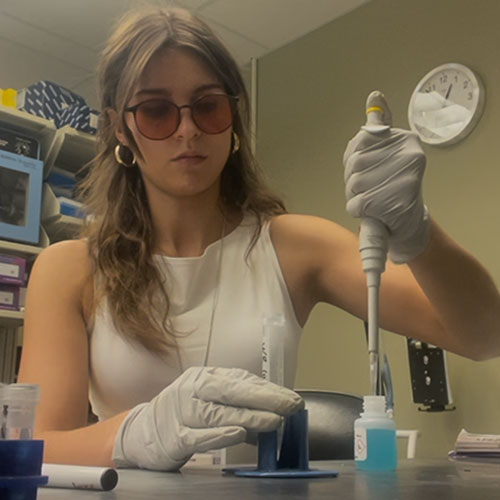
Chrissa Baldy ’26, a neuroscience major at The College of Wooster, spent the summer in Baltimore, Maryland, as a summer research assistant at Johns Hopkins School of Medicine. While on-site, Baldy studied a rare pain disease called Schwannomatosis, a genetic disorder that promotes tumor formation on peripheral nerves and results in severe, chronic pain. With a focused path in cognitive behavioral neuroscience, Baldy integrated biology and neuroscience in her studies to learn more about the disease and aid with improving the quality of life for patients. Throughout an APEX Fellowship, Baldy gained insight with people-centered research and practiced necessary skills for a career as a translational researcher.
“Recognizing the resilience and adaptability I gained this summer, I plan to continue strengthening my skills by actively seeking out challenging research environments that push me to think critically and remain flexible under pressure.”
—Chrissa Baldy ’26
FINDING OPPORTUNITIES
Baldy: Believe it or not, I learned about this internship through my Spanish class. One of my classmates casually mentioned that his mom is a neurology professor at Johns Hopkins, and my ears immediately perked up. I asked him about her work and whether she might be looking for interns. A few days later, he shared her contact information and let me know she’d be open to a conversation. Despite not knowing much about the Schwannomatosis disease, her mission to understand and develop treatments for it resonated deeply with me. The opportunity to contribute to research aimed at improving the quality of life for patients was incredibly exciting.
EXPANDED PERSPECTIVE
Baldy: I am most interested in understanding the underlying biological mechanisms that cause the disease to manifest in affected patients. My tasks in the lab varied from day to day, but I mostly worked with human tumor samples. In the first few weeks of my internship, my role primarily centered around culturing media from the cells of painful tumors. I then transitioned to a project focused on Fluorescence Activated Cell Sorting that never came to fruition for reasons outside of my control. Towards the end of my internship, I spent time performing protein analyses of the tumor samples and authored the introduction and background sections of the lab’s future publication.
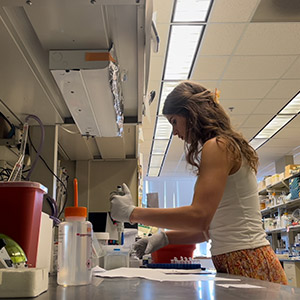
Baldy gains lab skills while working at Johns Hopkins. Photo provided by subject.
LESSONS LEARNED
Baldy: Throughout my internship, I honed my foundational lab techniques, such as sterile pipetting, cell culture, and quantitative protein assays, while also gaining fluency in executing experimental procedures. Beyond technical skills, I’ve deepened my ability to synthesize findings and communicate them through impactful scientific writing. These skills are crucial to scientific research and will continue to guide my work in neuroscience.
WHAT’S NEXT
Baldy: This summer shifted how I see myself as a researcher. I used to worry that biology was too complex for me, which led me to focus more on behavioral neuroscience. This APEX Fellowship has shown me that I do have a place in biology-based research, and that I genuinely love exploring disease mechanisms. Recognizing the resilience and adaptability I gained this summer, I plan to continue strengthening my skills by actively seeking out challenging research environments that push me to think critically and remain flexible under pressure. I’m now excited to pursue experiential-based programs abroad to build on that foundation.
Featured image: Chrissa Baldy ’26 completed an APEX Fellowship at Johns Hopkins over the summer. Photo provided by subject.
Posted in Experiential Learning, Showcase Stories 2025 on August 6, 2025.