

History major investigates 1970s music genres
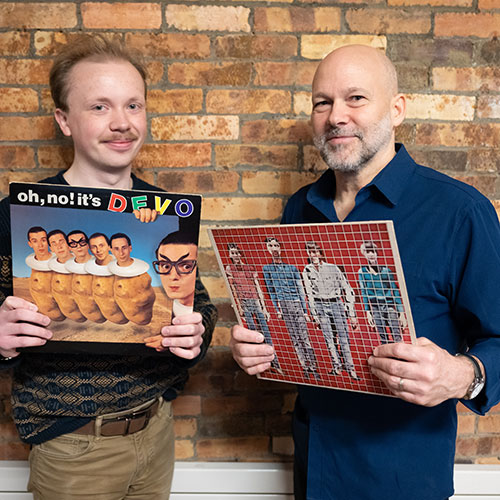
Zach Perrier ’25 always knew he wanted to major in history. But ultimately, he chose to attend The College of Wooster because the music drew him in. “Wearing a kilt in the marching band is always a big draw,” said Perrier, a music minor. The tuba and sousaphone player also hosted a weekly campus radio show on WOO91, where he served as general manager.
Last summer, Perrier interned at the Rock & Roll Hall of Fame Library and Archives—an exciting opportunity that intertwined his two academic interests. He was wrestling with how to expand his junior Independent Study topic about eminent domain in Cuyahoga Valley National Park when the music drew him in yet again.
While interning, Perrier organized the Cary Baker Papers (articles, interviews, and correspondence from the music journalist and publicist) that shed light on late 1970s/early 1980s independent music scenes. He and another intern also processed and photographed a record store display about new wave and punk bands like the Ramones, Dead Boys, and others. With such rich sources at his fingertips, Perrier couldn’t resist starting fresh with a new topic for senior I.S.
His study examined the transition from the early New York punk and new wave scene to a national movement during the late 1970s and revealed how the recording industry eased the change from a scene-based to an industry-based genre. Perrier leaned on music journalism and oral histories to explain the context of the music scene, as well as case studies on label executives and acts like Patti Smith Group and Richard Hell to show the push and pull of musicians and the industry.
Gregory Shaya, Henry J. and Laura H. Copeland Professor of European History at the College, served as Perrier’s I.S. mentor. “Zach shows the ways in which these bands worked in creative tension with the record companies that signed them and marketed them to a national audience,” Shaya said. “He revealed how the very category of ‘new wave’ appeared out of a delicate truce between art and commerce.”
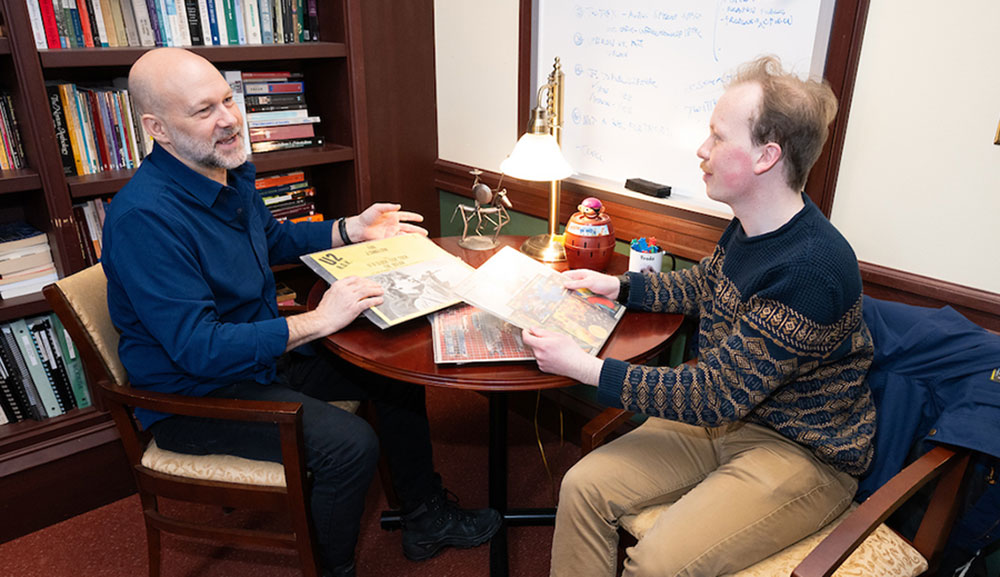
Shaya and Perrier enjoyed learning about the rise of new wave music and the marketing that shaped it.
On top of months of research on genre theory and the music industry, Perrier spent three days during fall break in the Rock Hall archives pulling primary sources that tell the larger story. He combed through business files from Sire Records, which, in addition to signing bands like Talking Heads and the Ramones, also collaborated with Warner Records on the in-store display and ad campaign that intrigued Perrier during his internship.
He found a noticeable shift in marketing authenticity after Sire co-founder Seymour Stein got “usurped into the machinery of the major labels.” While executives signed bands out of the underground Manhattan club circuit, they also promoted bands from other countries and merged them into one new wave genre.
“There wasn’t really a sense of place in the campaign visuals, and the labels robbed it of authenticity,” explained Perrier. “Punk and new wave music brought feelings of alienation that defined youth culture in the 1970s. That’s cropped up today and led to a hunger for authenticity in music.”
Perrier, who worked in digital collections at Andrews Library archiving I.S. files, also found sources on campus. Regardless of sources, he found it hard to talk about music in just words. “I was really inspired by the Rock Hall exhibits and wanted to create a digital companion,” said Perrier. The website (howdidigethere.collegeofwooster.net) he created includes original recordings from Manhattan clubs, press photos, and flyers.
His peers’ projects also inspired him; he noted a friend studying music played during campaign rallies. “She and I often helped each other while putting our websites together as a second set of eyes and bouncing ideas off one another. Mine isn’t as intense in data collection, but we both saw the power of digital storytelling.”
His I.S. wasn’t Perrier’s first effort on the digital side. He created two digital exhibits at the Baseball Heritage Museum during a summer 2023 internship. Between that and his Rock Hall experience, he understands what’s needed for researchers. “Archivists are researchers too, and it was helpful to see both sides of that relationship,” said Perrier. He expects to explore that relationship more this fall when he begins a master’s program in library and information science.
Featured image: Zach Perrier ’25 stands with Gregory Shaya, Henry J. and Laura H. Copeland Professor of European History, proudly displaying a couple of 70s vinyl records.
This story originally appeared in the summer 2025 issue of Wooster magazine.
Posted in Independent Study, Magazine on June 23, 2025.
Related Posts

Related Areas of Study
Music
Earn a bachelor of arts in music or a bachelor of music in either music performance or music composition
Major MinorHistory
Critically examine events and societies of the past and learn to tell the stories future generations need to know
Major Minor