
Archaeology and geology major directs research on-site in Guatemala for summer internship
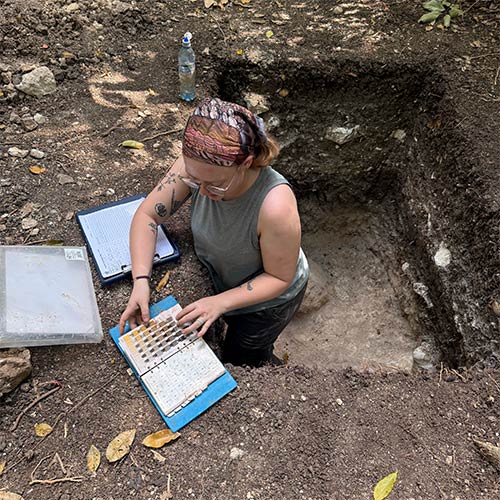
Ryann Taylor ’26, an archaeology and geology major and religious studies minor at The College of Wooster, spent the summer at the archaeological site of El Perú-Waka’, an ancestral Maya city in Guatemala. As a collaboration between Guatemalan and American researchers, Proyecto Arqueológico Waka’ (PAW) focuses on archaeological research on the site, uncovering new information about Mayan civilization. Working under Olivia Navarro-Farr, professor of archaeology, anthropology, and sociology at the College, Taylor dived into field work centered around soil testing within the test pits. Funded through an APEX Fellowship, Taylor improved her lab skills on-site through directing test pits and developed her Spanish through daily communication with those at the sites. Taylor learned about her strengths in archaeology fieldwork throughout the summer experience.
“My Spanish skills and field basics have grown tremendously while working on-site, and I hope to take these improved skills and apply them to a new area of the world.”
—Ryann Taylor ’26
FINDING OPPORTUNITIES
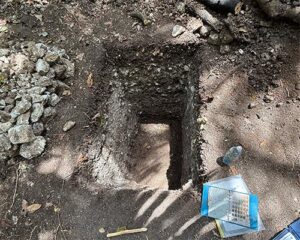
Taylor’s day-to-day work included gathering data from inside the test pits at El Perú-Waka’. Photo provided by subject.
Taylor: I learned of this opportunity through Professor Navarro-Farr. She is a co-director of the site I worked with this summer. This experience was a good fit for me because it allowed me to get in-field experience to help guide me towards a future career in the archaeological field.
EXPANDED PERSPECTIVE
Taylor: Working within these test sites was really interesting because every test pit was completely different, both in size and material. Each day in the field I would hike 2.5 miles to the site, where I would then help direct the test pits (all in Spanish) and conduct all the soil tests on the test pits for the field season. It was a really big task since there were about 60 test pits and four-to-five soils per pit. My Spanish skills and field basics have grown tremendously while working on-site, and I hope to take these improved skills and apply them to a new area of the world.
GUIDANCE FOR GROWTH
Taylor: My fellowship advisor was Dr. Elizabeth Schiltz, Purna, Rao, Raju chair of philosophy. The feedback I received on my weekly logs and reports was really helpful, especially while I was in the field. I wasn’t expecting some of the work I completed, and it was hard to adjust to the jungle. Dr. Schiltz always made sure to recognize my hard work and commend me on doing well.
WHAT’S NEXT
Taylor: This internship helped me realize that I love archaeology and the work associated with it, but academia and Mesoamerica may not be the subspecialty for me. Instead, I have decided to focus on more public-facing archaeology, such as governmental- or museum- based archaeology.
Featured image: Ryann Taylor ’26 conducting soil tests within a test site. Photo provided by subject.
Posted in Experiential Learning, Showcase Stories 2025 on August 6, 2025.
Related Posts

Related Areas of Study
Religious Studies
An interdisciplinary, academic approach to the study of religion that includes history, art, theology, and more.
Major MinorGeology
Start research in your first year and graduate with a strong foundation in the Earth Sciences.
Major MinorArchaeology
Fieldwork and research are a big part of the study of prehistoric and historical archaeology
Major Minor