

Wooster physicist Niklas Manz goes beyond his discipline to study how phenomena get their names
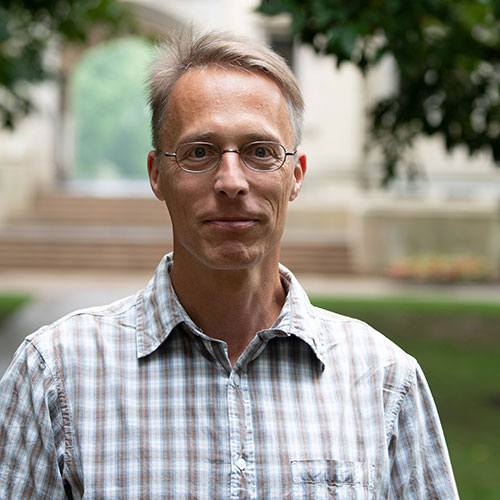
Niklas Manz, associate professor of physics at The College of Wooster, studies the Belousov–Zhabotinsky reaction, but why was it named for those two scientists, instead of one or instead of six or seven? Manz was curious. His interest in how discoveries get their eponyms, the people or person they are named for, resulted in two recently published papers outside of his normal field.
Most have heard of Einstein’s theory of relativity, Newton’s law of gravity, Parkinson’s disease, and many more, but hundreds of more obscure phenomena are also named after their discoverers, and one of the first things Manz found is that in recent decades, the names have been getting longer.
“Different fields have different thresholds,” he said, and in recent decades, the thresholds have been getting lower in every field, so that discoveries may now carry the names of five or six researchers. Because scientists want their information condensed, he notes, the eponym often gets abbreviated, so the Belousov–Zhabotinsky reaction becomes the BZ reaction or the Fisher–Kolmogorov–Petrovsky–Piskunov equation becomes FKPP equation.
Manz eventually split his research into two papers. The first, published in the journal Chaos, traces the history of the BZ reaction’s eponym. The second paper, published in Scientometrics, looks at the broader question of how scientific discoveries get their names and what the threshold is to be included.
Much of the early research on the BZ reaction was published in Russian journals, and transliteration into the Western alphabet introduced many variations on names. Manz worked with Zach Rewinski, formerly assistant professor of Russian studies at the College as a co-author on the Chaos publication. For the Scientometrics article, he collaborated with the College’s science librarian.
“Working outside our own departments is sometimes really necessary,” Manz said, “and it’s great that it’s possible.” At a big university the two might never meet, he said, but at Wooster, “I just went to his office and asked if he was interested in joining the project.”

Belousov–Zhabotinsky Reaction illustration by Tara Brunner ’24
Wooster’s other cross-disciplinary contribution to Manz’s Chaos paper was the illustration, created by Tara Brunner ’24. “I’m creative in the lab, but not visually creative,” Manz said, so he contacted the art department and was connected with Brunner to create a visual spiral of all the names that have been associated with the BZ reaction.
As a physicist, Manz studies reaction-diffusion waves. The BZ reaction is a chemical system, but its wave properties are useful to a physicist and present yet another opportunity to reach across disciplines. “I have Petri dishes and pipettes in my lab,” Manz said, “but I try to tell physics majors that chemists use a lot of physics, and I’m using chemistry to investigate physical properties.”
Manz’s sabbatical leave in 2024 made it possible for him to do the deep dive into scientific literature that was required for the two papers. “It was a completely different part of my brain,” he said, comparing the work to his usual research focus. In whatever field, he appreciates the opportunities that he gets at Wooster to stretch himself. “I like research, but I also like teaching,” he said, “and that’s not possible at a big university in the same way.”
Posted in Faculty, News on August 26, 2025.
Related Posts


Related Areas of Study
Russian Studies
Build language skills and take an interdisciplinary approach to learning the history, literature, and culture of Russia.
Major MinorPhysics
With one-on-one guidance from a faculty mentor, every physics major completes independent research in a year-long research project
Major Minor