

Future Students
Answers to all of your questions about Wooster start here.
- Academic Programs
- Independent Study
- Career Success
- Financial Aid
- Campus Life
What you're curious about shapes the education you get at Wooster. Classes average 13 students, professors know you by name and by what you're working on, and the questions you arrive with have a way of becoming considerably more interesting by the time you leave.
Rankings and outcomes that reflect what four years of close mentorship and independent work actually produce.
Senior Capstone
U.S. News & World Report
Most Accessible Professors
The Princeton Review
Best Schools for Internships
The Princeton Review
Post-College Placement
Employed or in grad school within 9 months
Wooster offers more than 80 areas of study, from biology to business economics, political science, education, and the arts, and you don't need to know on day one which direction will define your next four years.
Whatever you end up studying, every Wooster student finishes the same way: a year-long, mentored capstone project on a topic entirely of their own choosing.
With more than 90+ student organizations, the ways to get involved at Wooster are as varied as the students who show up.
From March Through the Arch to an I.S. Tootsie Roll, Wooster's traditions mark the moments that matter and connect you to 26,000 alumni who share them.
More than 70 stage performances a year and a student-led Annual Culture Show anchor a campus where creativity is an essential part of life.
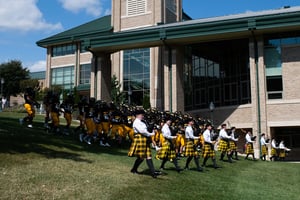
Bagpipes lead the Fighting Scots football team onto the field, and that same spirit carries across 23 NCAA DIII teams and 400+ students competing in club and intramural sports.


Real stories from students, alumni, and families
Being part of the Wooster community means I have multiple places on campus that I can be truly and fully myself, and there is always a group I can find community in.
I can't pick just one professor or advisor — the collective support I've received at Wooster has helped mold me into who I am today.
As a first-generation student, financial aid makes it possible for me to attend The College of Wooster and has opened opportunities for me.

Wooster's application is test-optional, and with 99% of admitted students receiving some form of aid, there's more support available than you might expect.
Merit scholarships ranging from partial to full tuition
All awards guaranteed for up to 8 semesters
Estimate your cost before you apply with our Early Aid Estimator

.png?width=64&name=Background%20(4).png)
.png?width=64&name=Background%20(5).png)
.png?width=64&name=Background%20(6).png)
.png?width=64&name=Background%20(7).png)




.jpg?width=300&name=IMAGE%20(1).jpg)


