
Statistical and data sciences major communicates effects of wildfires on communities
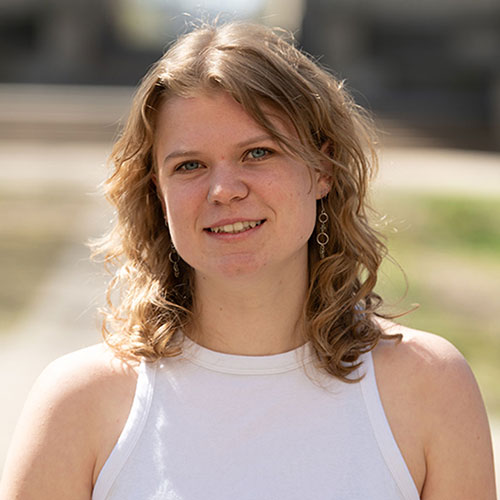
Growing up in northern California near the Santa Cruz Mountains, Laurel Andrews ’25 loves the outdoors. She found a way to indulge her enthusiasm as a student at The College of Wooster through WOODs Club, a student group she traveled with to Joshua Tree National Park in California, Arches National Park in Utah, and other locations to explore and revel in nature’s wonders. At 16, Andrews experienced a natural disaster that became one of the largest wildfires on record in California.
“I remember looking out and seeing dark red skies. There was ash everywhere. I had friends whose homes burnt down, and it was scary,” said Andrews, who found the experience really shaped her. “I remember not seeing it represented much in the media. I felt like climate change was on my doorstep in a way that wasn’t being accurately portrayed, and wildfires have only gotten worse since then.”
A statistical and data sciences major, Andrews explains, “Data science is a combination of stats and computer science. We use coding to convert big, messy data sets into visualizations you can gain information from.” When she planned her Independent Study, she approached her passion for understanding how climate change affects the environment with that perspective. “Climate change affects people deeply, and that’s where the humanities come in. You can look at so many numbers, but at the end of the day, it’s affecting people in a way that it’s super important to study. My liberal arts education led me to approach climate change in an interdisciplinary, multifaceted way.”
Andrews received National Science Foundation funding through the Research Experience for Undergraduates program at Southern Methodist University in Dallas, the summer before her senior year, and the experience inspired her to pursue data storytelling—using a narrative to present data insights. In conversation with her I.S. mentor, Colby Long, assistant professor of mathematics and statistical & data sciences, she narrowed her focus to explore increasing wildfire trends and their societal and environmental effects.
Andrews’ research incorporated three parts. The background research part applied her knowledge from her earth sciences minor about the climate, evaluating natural and anthropogenic (human) causes and effects. “Areas that have burned will shed more of their topsoil, polluting waterways, which has a number of effects on aquatic ecosystems, but also on humans,” she said. Among other chain reactions, she realized, wildfires burn plastics, particularly in urban areas, as seen in January during the Eaton and Palisades fires in Los Angeles. “Plastic is not meant to be burned,” she said. “It releases smoke that’s even more toxic than regular wildfire smoke. Burning plastic leeches microplastics into the water, which are harmful to humans and to local ecosystems.” The fires in LA interested Andrews when they coincided with her research from the fall. “LA’s wildfires burned a significantly greater number of buildings, businesses, and people’s homes than other fires of similar sizes,” she said, noting the amount of destruction, including evacuations, downed power and gas lines, lost communities, and climate migration, made it one of the costliest natural disasters in U.S. history.
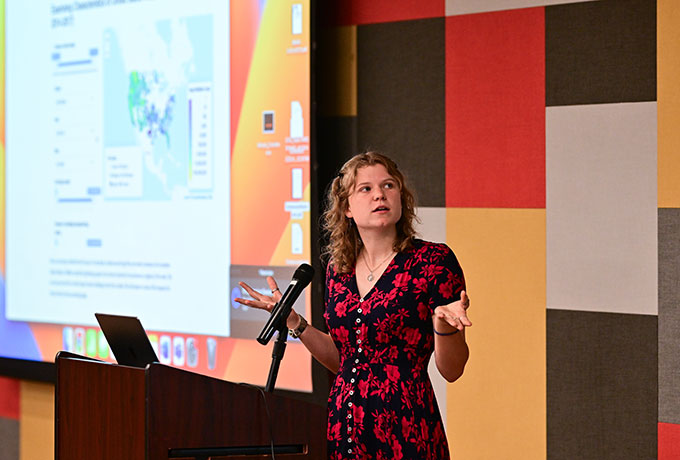
Laurel Andrews ’25 presents studies at Senior Research Symposium.
The second and third parts of her I.S. leaned into the science communication aspect of data science—“making climate change research accessible to the average person,” she explained. “I want anyone with any amount of knowledge about wildfires or data science to be able to look at my final project and gain awareness of how large of an issue wildfires are and the ripple effects of climate change.” First, she gathered a total of seven data sets through sources including FEMA incident reports, the National Oceanic and Atmospheric Association, census data from the American Community Survey, among others, then cleaned and analyzed the data, and finally used a new software she and her advisor hadn’t used before to code the data sets into maps, graphs, and interactive elements on a website for a wider audience to explore.
“Working in statistical and data sciences provides a set of tools to tackle problems in incredibly disparate areas,” said Long, who noted that Laurel took the lead on approaching a project of personal significance to her. “From our first meeting, Laurel had ideas about what she wanted to do outside my area of expertise. I offered guidance and helped with managing a project of this scope, but it was great to see a student take the lead—and we both got to learn some new things!”
“Taking on an ambitious I.S. empowered me to try something totally different and new,” said Andrews, adding, “If I can do something small that will help educate some small portion of people in a cool way about climate change, that is important to further mitigation efforts.”
The network of seniors completing I.S. together during senior year gave Andrews a support system to rely on. “The general support of everyone going through the same things at the same time made I.S. feel a lot more doable,” she said, sharing that she asked friends in other majors to look at ideas and data, which she presented to see if it made sense for other audiences.
After completing I.S., she traveled to Palo Duro Canyon in Texas with the WOODs Club. First, taking some hammock time in Oak Grove before graduation and working as camp director at a gymnastics day camp in Santa Cruz, she’s considering a field research role gathering data and sees herself working for an environmental protection organization in the future.
Featured image: Laurel Andrews ’25, a statistical and data sciences major, used her Independent Study to inform about wildfire effects.
This story originally appeared in the summer 2025 issue of Wooster magazine.
Posted in Independent Study, Magazine on June 23, 2025.
Related Posts


Related Areas of Study
Statistical & Data Sciences
Use statistics, math, and computer science to gain insights into data and solve real-world problems.
Major Minor