
Social Entrepreneurship program celebrates 20 years of student research for community impact
Students don’t come to Wooster expecting a front-row seat to how businesses solve real-world problems, but through the Social Entrepreneurship (SE) program, they learn collaboratively with change makers building a social change ecosystem. This year marks two decades of the faculty-led experiential learning seminar where students gain valuable experience while organizations in the community reap the results of their work.
Conceived in 2005 by a group of faculty led by John Sell, emeritus professor of economics, SE launched in 2006 with an inaugural grant from the Burton D. Morgan Foundation. Since then, the program has served more than 40 clients whose missions solve social problems like food insecurity, affordable housing, access to education and art, and more, providing more than half a million dollars of value each year.
“SE was our initial foray into entrepreneurship education at the College,” said Amyaz Moledina, program co-founder and professor of economics. Melanie Long, associate professor of economics, who also advises SE student teams said, “People often think of entrepreneurship in a traditional business sense, but this is interdisciplinary work that also requires an awareness of the social problem we’re trying to solve and which groups are impacted,” said Long, noting that the program includes faculty, staff, and students from across the College.
SE’s for-credit seminar takes place most often during spring semester. The faculty work with community organizations to curate one to four projects each year. Then students are recruited to do the research in teams advised by faculty. A team of students this year hopes to conduct an impact analysis and compute the social return on investment of the program. Initial results suggest after 20 years, these local projects have made a tangible financial, social, and environmental impact on more than 10,000 people a year in Ohio.
Cameron Maneese ’79 serves on the Board of Trustees for The Lyric Theater (formerly the Downtown Arts Theater) and turned to SE in 2019 as part of a group of citizens looking to renovate and reopen the 1979 venue. After already experiencing a successful collaboration with SE in 2015 when she worked at the United Way of Wayne and Holmes Counties, Maneese sought help developing a comprehensive plan that looked at sustainability and how membership programs help the theater’s bottom line. “The team’s research was invaluable. It formed the foundation for the Lyric’s successful membership program,” said Maneese.
Another repeat client, Tiffany Leeper, development manager at Wayne Center for the Arts, said she knew SE would deliver a high-quality feasibility report for a new arts therapy program close to the caliber of a well-established research firm for a manageable cost. “Nonprofit organizations are notoriously lean, and there often isn’t much set aside in the budget for expensive studies,” said Leeper. “But funders want to see that an organization has done their homework and provided evidence of need and feasibility.”
SE provides a win-win for the community, faculty, and students who often go on to SE-inspired work. Wooster geology grad Annette Hilton ’17 recently earned her Ph.D. in environmental science and management. Killbuck Watershed Land Trust fully implemented the spring 2015 business plan she wrote alongside Matt Mariola ’98, associate professor of environmental studies and long-time program advisor. Now a postdoctoral fellow at University of California, Davis, Hilton’s work continues incorporating community and citizen science in a garden rehabilitation program in California prisons.
“SE gave me some realism in understanding how sustainable change takes time and effort on the part of many individuals,” said Hilton. “It helped me think about the scope of where I wanted to devote my efforts as an environmentalist and gave me some experience to understand if nonprofits were a place I’d want to work in the future.”
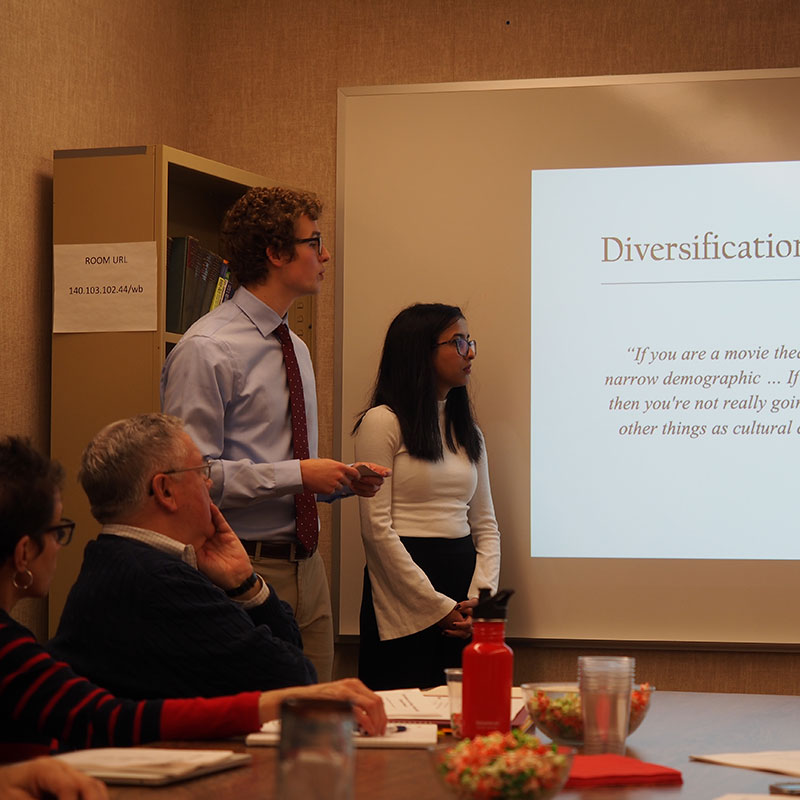
Featured image: Blake Southerland ’20, business economics major, (left) and Bijeta Lamichhane ’22, communication studies and mathematics major, present membership program research and plan recommendations to the Lyric Theater’s board in 2019.
This story originally appeared in the fall 2025 Annual Report.
Posted in Homepage Featured, Magazine on November 11, 2025.