

English alumnus blazed the trail to video game design with Fortnite
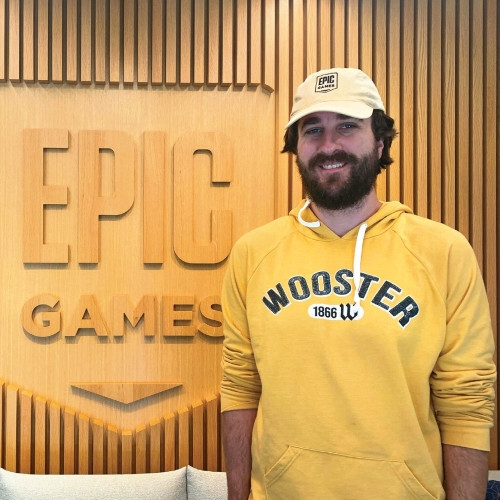
It might not be surprising that someone with a writer and creative director for parents, who also has a Pulitzer Prize-winning journalist as a grandfather, pursued an English degree. In fact, Will Strohmeyer ’19 said he knew very early on he wanted to explore the field of writing. “I grew up appreciating writing and that space impassioned me to do my own creative work,” he said. But there’s another influential space—one that he now helps design for millions to experience around the globe—that also influenced his path.
“I loved playing video games that were heavily focused on stories because they offered a different way of digesting a story compared to reading or watching a film,” explained Strohmeyer, recognizing how this also played a role in his declaring an English major at The College of Wooster. While he never expected the teenage hobby to lead to something more than that, today, Strohmeyer works at Epic Games as a gameplay designer on the pop culture phenomenon Fortnite: Battle Royale.
The game’s main objective is to be the last one standing on Battle Royale Island. Players can “loot, build, explore, and fight,” according to its website, to overcome 99 other players in the match. Strohmeyer’s team decides what players can do as their chosen character and what weapons, gadgets, and abilities they can use to help themselves or their team win the match. Major updates they produce, called seasons, each showcase a unique theme. “We’re in charge of figuring out how to deliver the themed experience to the player,” said Strohmeyer. “I worked on a key item called the Typhoon Blade that was featured in the December release of Chapter 6 Season 1: HUNTERS. It’s a sword that gives players many abilities when they’re wielding it like unleashing a powerful samurai slash.”
After brainstorming ideas for each season, Strohmeyer uses Epic’s own software called Unreal Engine to bring those ideas to life in the game itself. Then he collaborates with talented artists, audio technicians, and programmers who merge the vision together. “Most of what we do is to bring enjoyment to players and suspend their disbelief for a little bit,” said Strohmeyer. The end product creates a fantastical world where competitive and social players alike flock.
Understanding unique perspectives of players and colleagues is an important skill, and it’s one that Strohmeyer honed at Wooster after adding a Spanish major. Hernán Medina Jiménez, associate professor of Spanish, and others in the department reignited his love for learning another language—something he’d spent five years doing before college. “A second language opened up a whole other side of writing that took form in Spanish novels, media, films, and video games,” recalled Strohmeyer.
Similar to a gamer experiencing a new world, Strohmeyer immersed himself in the language and culture by studying abroad in Havana, Cuba, and participating in Wooster’s Spanish-speaking residence hall. He discovered unique syntaxes in Cuba as well as perspectives on U.S.-Cuba relations that “broke him out of his own bubble.”
Back in English classrooms, he learned to critically think through different source material and take apart themes and motifs. He emphasized, “Critical thinking is one of the greatest skills you can get, and it’s not always taught in purely technical programs. It’s something that’s valuable for any creative, and it serves me well every day.”
When it came time for his Independent Study, Strohmeyer’s mentor, Medina, was the first to enthusiastically support his idea. The joint project defined and contrasted various portrayals of a concept called “lo real maravilloso” (which translates to “marvelous reality”) in literary and video game mediums. He pursued the topic after playing an independent creator’s video game, Papa & Yo, created by Colombian Victor Caballero. Players have to escape a realistic Colombian slum alongside “Monster,” a magical being that can help—or harm—the player.
“This literary device, invented in the early 20th century, was something I felt like I could represent in a 21st century video game of all things, and that was really compelling to me,” said Strohmeyer. “When we work with concepts of the past in Fortnite, I feel better equipped having worked on this I.S. because I can understand how other games have done that before.”
His study also provided the confidence to apply to a master’s program in game and interactive media design at the University of Utah. “I.S. opened up a new space in my mind, and that’s when I thought maybe there is some way that I can loop games and creativity into my career,” said Strohmeyer. “In many ways Wooster prepared me more than my time at Utah. Nothing can replace the work ethic I developed at Wooster.”
This feature originally appeared in the Spring 2025 issue of Wooster magazine.
Photo provided by Strohmeyer.
Posted in Alumni, Magazine on March 13, 2025.
Related Posts


Related Areas of Study
Global Media & Digital Studies
Digital technology, mass media and film studies are part of a dynamic, interdisciplinary course of study
Major MinorEnglish
Students benefit from the small classes and access to faculty members in the small private liberal arts setting at Wooster.
Major Minor