

Rae Harris ’25 explores connections between ancient philosophy of sense perception and current neurobiological understandings

Rae Harris ’25, a neurobiology and classical studies major at The College of Wooster, noticed that a classical philosopher was only mentioned once in their STEM classes. They found the lack of philosophical representation odd, “because ancient philosophers asked the same questions about psychological phenomena that neuroscientists ask today—questions about memory, sleep, behaviors, and sense perception,” Harris said. “Philosophers are often dismissed due to their incorrect conclusions.” A Sensory Biology course that included readings on current research in vision, taste, and smell, piqued Harris’s interest in sense perception. “We could all be looking at the same thing but have an entirely unique experience of it,” they said. “Across species and across individuals within the same species, there is an incredible amount of variation.”
“My project was extremely interdisciplinary and allowed me to combine all my passions in a single project, from current day sensory biology to the ancient philosophies of Plato, Aristotle, Lucretius, and Galen about the sense of perception. I was struck how similar their models were to what we know today.”
—Rae Harris ’25
MY I.S.
Harris: For this project, to demonstrate how philosophy is still relevant within STEM classrooms, I compared the mechanisms of ancient sense perception models to the modern neurobiological understanding, specifically investigating the visual system. I argued that while philosophers often erred in their conclusions, the process by which they reached those conclusions, and the impact of their findings still deserve recognition in a modern setting. Though the classical and modern visual pathways appear very different, the underlying logic of the models is incredibly similar, encouraging us to acknowledge the contributions of the philosophers who began asking the questions that scientists later sought to answer.
EXCITING ASPECTS
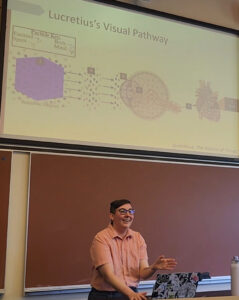
Harris presented their I.S. at the Philosophy Roundtable on May 1, 2025, at Scovel Hall. Photo courtesy Rae Harris.
Harris: My project was extremely interdisciplinary and allowed me to combine all my passions in a single project, from current day sensory biology to the ancient philosophies of Plato, Aristotle, Lucretius, and Galen about the sense of perception. I was struck how similar their models were to what we know today. They didn’t have our advanced technology and were working off observation (and sometimes animal dissections) to draw their conclusions. It amazed me that they could make such plausible models from observation alone. With a passion to make technical science, and in this case, philosophy, available to a wider audience, this project gave me the opportunity to explain complex neuroscience to non-STEM individuals and explain philosophy and ancient Greek and Roman culture to non-philosophers.
EMPOWERED IN MY FIELD
Harris: Turning my ideas into a real, solid thesis was truly an eye-opener. It’s one thing to brainstorm ideas and make a mental conspiracy board with strings jumping from one idea to another, and something else entirely to dive into the literature, annotate many, many texts and find more connections than I ever thought possible. While I.S. gave me both the skills and resources needed to piece my project together, it also forced me to hold myself accountable and allow flexibility to rule my schedule, something I never thought I was capable of. I learned to give myself grace and allow myself the freedom to step outside the ridged outline of my project. With this flexibility, I was able to explore beyond the mechanisms of sense perception and vision and into the realm of cultural significance and the challenges of truly seeing as the ancients did.
SUPPORTIVE SCOT COMMUNITY
Harris: With such an interdisciplinary project, I leaned on various professors from the neuroscience, philosophy, and classical studies departments to uphold the quality of my research. They acted as my second (third and fourth) pair of eyes to help me explain the complex philosophy and neuroscience in a way that would be understandable to most people. My advisor, Josephine Shaya, Marian Senter Nixon Chair in Classical Civilization, was an amazing sounding board, giving me the motivation to push through and keep writing. My friends and classmates, especially my fellow seniors, offered a strong community for emotional support and sound advice throughout the process.
MY TAKEAWAYS
Harris: The greatest thing that I.S. taught me is that even when you’re the one driving the project, it’s okay to reach out to others for support, and it’s okay to need that support. No work is done completely in isolation and I became comfortable using the resources available to me. One of the professors that greatly helped me was someone I had never spoken to before. With only one meeting, I was inspired to consider pursuing some aspects of my research after graduation. It’s an amazing experience to see your own interests reflected back at you and speaking with others really demonstrates the reach of that interest. I’ve never been one to willingly seek out others but I.S. has given me the skills to do so in the future.
CELEBRATION
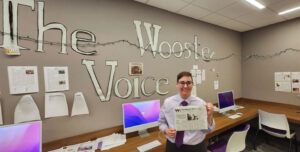
Harris was editor-in-chief for The Wooster Voice. Photo courtesy Rae Harris.
Harris: I celebrated by turning in my I.S. prior to spring break alongside a good friend and going out for a celebratory meal. Turning in with a friend amplified the excitement and joy of the moment. It was less about what I did and more about who I did it with. It was rejuvenating and when I.S. Monday came around, I was able to simply enjoy the moment. The greatest highlight of I.S. Monday was march through the arch. The air was filled with joy and excitement and pride in what we had accomplished. It was amazing to have everyone gathered in one place to celebrate.
WHAT’S NEXT
Harris: After graduation, I will be entering the workforce as a member of an editorial team at October Research, a real estate publishing company. Ultimately, I hope to work as a copy editor for a scientific journal. I want to make scientific research more accessible to the public by making the language itself more accessible and less technical.
Featured image: Rae Harris ’25, photo provided by subject.
Posted in Independent Study on June 16, 2025.
Related Posts


Related Areas of Study
Neuroscience
Psychology, chemistry, philosophy, computer science, and other disciplines combine in the study of the nervous system
MajorClassical Studies
The languages, literature, history, myths, philosophies, and archaeology of the Ancient Mediterranean
Major Minor