

Biochemistry and molecular biology major explores MDR bacteria risks and defenses
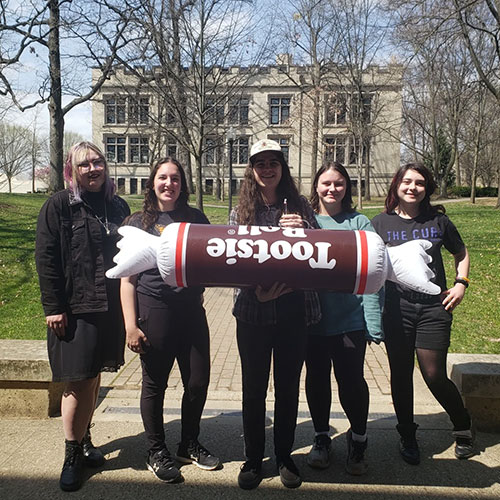
Helena Davis ’25, a biochemistry and molecular biology major at The College of Wooster, grew fascinated by bacteriophages through her research as a student. A type of virus that targets other viruses, bacteriophages have been widely studied due to their largely unknown characteristics. Davis, interested in this rare virus, centered her Independent Study on bacteriophages and their use against MDR bacteria, a growing concern currently in the medical world.
“I.S. has taught me the importance of tenacity as a key quality for any scientist to have.”
—Helena Davis ’25
MY I.S.
Davis: My I.S. deals with a unique kind of virus, a type of bacteriophage, and how it is being considered as a tool to deal with the growing threat of multi-drug-resistant or MDR bacteria, the polyvalent phage. These phages can infect multiple species or even genera (the next category up) of bacteria and are very adaptable. I investigate whether their high mutation rates might make potential use in innovative therapies unsafe, as scientists have expressed concerns that they might mutate in such a way that they become able to infect our beneficial “good bacteria.”
EXCITING ASPECTS
Davis: To be able to work in such an interesting, re-emerging field built on century-old knowledge is an incredible privilege. I was happy to make even a small contribution of knowledge to the field, hoping to find alternatives to our conventional broad-spectrum antibiotics. Phage therapies have extraordinary potential for providing answers to dangerous MDR infections and other conditions such as sepsis.
EMPOWERED IN MY FIELD
Davis: I.S. was an amazing opportunity, allowing me to develop my own ideas as I dove into literature about phage therapy, an area of great interest for my advisor.
SUPPORTIVE SCOT COMMUNITY
Davis: My advisor’s thorough expertise and subject knowledge provided me with a solid foundation to work from throughout I.S. Without her support, I think I would have missed details crucial to the process of putting everything together and getting tangible results. I also spoke about I.S. with some of my peers, and their interest in my work inspired me to keep going!
MY TAKEAWAYS
Davis: I.S. has taught me the importance of tenacity as a key quality for any scientist to have. In scientific research, you will fail repeatedly before you ever get any sort of meaningful results. You must get up and keep going every single time. It’s also taught me just how thorough and involved even the smallest research questions can be, and the unbelievable depth of research that is out there in the modern era, where information is so freely available through the Internet. But most importantly, it taught me how satisfying having your own research under your belt can truly be, and the personal impact of contributing to one’s field.
WHATS NEXT
Davis: I plan to go into the biomedical/biotech field in the Boston area, working and picking up new skills as well as hands-on experience while paying off my student loans. After that, I plan to head back to graduate school to pursue a lifelong career in research. I hope to eventually attain a Ph.D. in biochemistry.
Featured image: Helena Davis ’25, a biochemistry and molecular biology major, researched bacteriophages as tools against drug-resistant bacteria.
Posted in Independent Study on June 20, 2025.
Related Posts

Related Areas of Study
Biochemistry & Molecular Biology
Biology and Chemistry combine in an interdisciplinary program for students with a passion for molecular events.
Major