

Biochemistry and molecular biology major investigates new peculiar phenotype
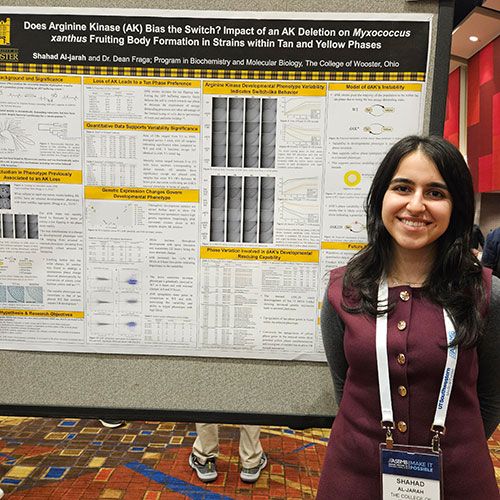
An Iraq native who was raised in Dubai, UAE, Shahad Al-jarah ’25 spent her time at The College of Wooster majoring in biochemistry and molecular biology with a minor in Chinese studies. On campus, she gained valuable experience working in Danforth Professor of Biology Dean Fraga’s lab all four years, joined the nationally recognized biology honor society Tri-Beta, and held leadership roles in Wooster’s Minorities in STEM student organization. MiSTEM encourages students who are part of minority groups to get involved in STEM-based activities to attract, recruit, and retain more students in scientific fields. Al-jarah’s Independent Study explored a phenomenon where arginine kinase protein led to changing phases of the bacterium Myxoccocus xanthus.
“Collaboration with classmates and faculty was essential for the completion of my project and it changed my previous understanding of science to now include community. As a result, I.S. allowed not only for gaining research skills but also newfound viewpoints that I can carry with me throughout my career.”
—Shahad Al-jarah ’25
MY I.S.
AL-JARAH: My project examined the involvement of a protein, arginine kinase, in the bacterium Myxococcus xanthus. In the lab, we noticed that deleting the gene coding for the protein resulted in the bacterium flipping phases more readily. Bacterial flipping is when genes have the ability to change form (essentially recoding genetics using the same material), and with these flips, the bacterium changed from yellow to tan. We built on previous research that examined the role of an arginine kinase deletion on the bacterium’s starvation response, but with the addition of the phase-change analysis. In the lab, we made deletion constructs in the bacterium, conducted tests to determine phase-flipping frequency, and ran starvation analyses to examine the developmental phenotype. Outside the lab, we continued the exploration of the starvation phenotype with quantitative data and further supported the phenotypic analysis by examining the genetic profile of each strain through RNA sequencing. This work then further aimed to characterize arginine kinase’s involvement in pathways other than the previously found role in protective mechanisms.
EXCITING ASPECTS
AL-JARAH: My I.S. was exciting because I was able to take leadership over my project in the lab I worked in for the past four years. I gained a better understanding of what it takes to research and, more importantly, troubleshoot. The excitement of finally overcoming a hurdle in the project brought immense joy and satisfaction after spending weeks hunched over the lab bench. These newly acquired skills ensured my love for research, prompting me to continue my education and attend graduate school.
EMPOWERED IN MY FIELD
AL-JARAH: I have worked with Myxococcus xanthus in the lab since my freshman year and as a sophomore researcher where I occasionally helped seniors with their projects. Through that work, my advisor, Dr. Fraga, and I noticed a new peculiar phenotype in which the bacteria began to change phase more readily. Genuine scientific curiosity pushed me to pursue an I.S. project where I could further explore this phenomenon and use previously acquired skills and lab techniques all the while learning new methods. This experience gave me confidence in my capabilities as a researcher, but I also learned the importance of seeking help and the expertise of others when exploring new aspects of the research. Collaboration with classmates and faculty was essential for the completion of my project, and it changed my previous understanding of science to now include community. As a result, I.S. allowed not only for gaining research skills but also newfound viewpoints that I can carry with me throughout my career.
SUPPORTIVE SCOT COMMUNITY
AL-JARAH: I was very fortunate to receive Copeland Funding for the RNA sequencing portion of my project. We took samples and sent them outside to get genetic profiling, then cleaned up and mapped them onto the genome. The results didn’t come back in time for my I.S., but they will get used by other students continuing the project and examining different aspects of it with Dr. Fraga this upcoming academic year. Dr. Fraga was also a great mentor who pushed me to always question my work and confirm what I was observing in the lab with further assays and repetitions. My friends and classmates supplemented the support given by my advisor and professors by always motivating me and providing me with confidence in myself.
MY TAKEAWAYS
AL-JARAH: Resilience and patience are the two main virtues I learned through constantly troubleshooting my experiments and overcoming frustrations with failed ones. I was able to think critically about tasks and step back to examine them from a different lens to try to uncover the phenomenon at hand. I gained confidence each time I conquered an obstacle. I also learned to rely on others and the importance of having a good support system. There were many times I had to stay in the lab or was overwhelmed with work when my friends stuck by my side and cheered me up!
CELEBRATION!
AL-JARAH: I started I.S. Monday celebrations by turning in my project with my friends. It was nice to celebrate my work from the past year with the people that have supported me throughout. I also participated in the scheduled events, eating lots of good food and walking the parade with all my peers.
WHAT’S NEXT
AL-JARAH: I will continue my education studying a Ph.D. in biochemistry and hope to return to academia afterwards as a professor.
Featured image: Shahad Al-jarah ’25, a biochemistry and molecular biology major, analyzed a unique phenotype with the bacterium Myxococcus xanthus.
Posted in Independent Study on June 20, 2025.
Related Posts
Related Areas of Study
Biochemistry & Molecular Biology
Biology and Chemistry combine in an interdisciplinary program for students with a passion for molecular events.
Major