

Computer science major creates intuitive smart-home system
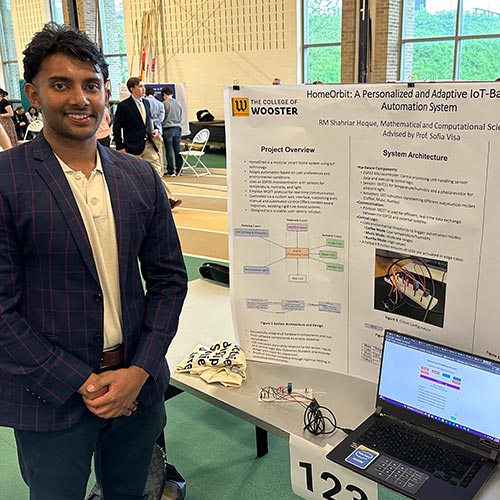
For his Independent Study at The College of Wooster, computer science major RM Shahriar Hoque ’25 combined multiple areas of interest within his department, from electronic-building to creative and critical design, to create a smart device that feeds off human behavior. His device, called a HomeOrbit, is different from current smart devices, as it was created with the intent to learn and adapt to the user, shaping the future of home technology. Hoque’s degree in computer science, along with his entrepreneurship pathway, allowed him to explore his interest in electronics and system management, which will directly aid him in future works as he continues his education and works on his startup.
“Working on this project felt like I was having a glimpse into shaping the future of how people interact with their living spaces.”
—RM Hoque ’25
MY I.S.
Hoque: For my senior thesis, I built a smart-home system called HomeOrbit. It’s similar to a personalized mini version of Alexa or Google Home, but instead of just turning things on and off, it learns individuals’ preferences. I used a small computer (an ESP32), a few sensors, and lights to create a home environment that responds to things like temperature, humidity, and light. I also built a web interface so people can see the data and manually control and interact with the system. The big idea was to show how smart homes can be more personal, adaptable, and responsive to people.
EXCITING ASPECTS
Hoque: What excited me most about my I.S. was the opportunity to bring together multiple disciplines in technology—including electronics, software, user experience, and design thinking—into a tangible product that can improve people’s daily lives. It made me understand the value of a system that can be adaptive and learn from behavior, the implications of which range from healthcare to assistive technologies. I loved the hands-on challenge of integrating sensors, coding real-time control logic, and designing an intuitive web interface. Working on this project felt like I was having a glimpse into shaping the future of how people interact with their living spaces.
EMPOWERED IN MY FIELD
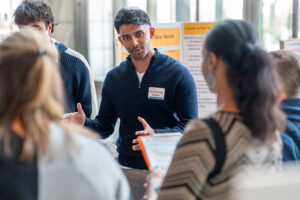
Hoque presents his I.S. results to guests at the I.S. Symposium. Photo courtesy RM Hoque.
Hoque: My project enabled me to take ownership of a complex abstraction and turn it into a functioning system from the ground-up. I enjoyed taking part in a creative process where every decision was mine to make. That level of autonomy pushed me to ask deeper questions like: “how can technology be more human-centric?” and “what does it mean for a smart system to truly adapt to its user?” I learned to troubleshoot independently, manage a development timeline, and balance technical precision with creative thinking. The experience gave me the confidence to further pursue ambitious projects that blend engineering with real-world impact.
SUPPORTIVE SCOT COMMUNITY
Hoque: I leveraged Wooster’s interdisciplinary culture throughout my I.S. journey. My advisor helped me turn big, abstract ideas, into a concrete plan, while faculty in the physics department guided me in configuring and troubleshooting the circuit. I also bounced concepts off friends from various majors, helping me refine details and turn my design into a working prototype. Their diverse perspectives and hands-on support were crucial, reminding me that collaboration across disciplines drives stronger, more creative solutions.
MY TAKEAWAYS
Hoque: I learned that real innovation happens at the intersection of disciplines: I had to draw on principles from computer science, physics, and human-computer interaction to bring HomeOrbit to life. More than anything, I.S. showed me how to lead a project independently, how to ask better questions, troubleshoot effectively, and stay committed even when things didn’t work the first (or fifth) time. It also taught me how to communicate complex ideas in accessible ways, which is just as important as the technology itself.
WHAT’S NEXT
Hoque: After graduation, I plan to pursue a master’s degree in computer science at Northeastern University to specialize in areas such as AI, Human-Computer Interaction and IoT. At the same time, I’ll also continue developing a startup I’ve been working on for the past year.
Featured image: RM Hoque ’25 with his I.S. Symposium poster. Photo courtesy RM Hoque.
Posted in Independent Study on June 20, 2025.
Related Posts

Related Areas of Study
Entrepreneurship
Identify opportunities and solutions that have value, then communicate that value to others
PathwayComputer Science
Solve complex problems with creative solutions using computer programming and applications
Major Minor