

Chilean student investigates surgery recovery and gender inequality
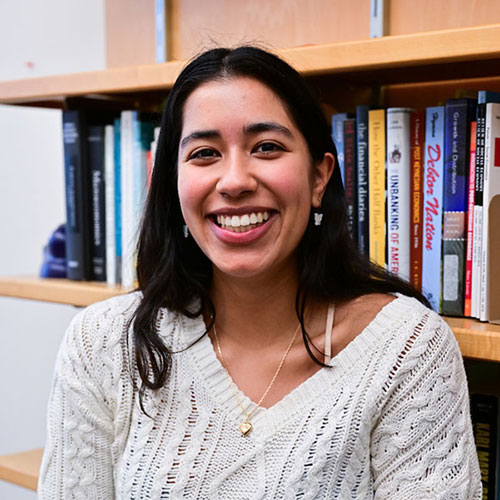
Growing up in Santiago, Chile, and seeing the country’s exponential growth that took millions of people out of poverty inspired Ignacia Méndez ’25 to pursue a career where she, too, can make a difference. As a sophomore at The College of Wooster, she interned with the Congressional Hunger Center in Washington, D.C., and helped research policy solutions to hunger-related issues with Bread for the World. When the time came for Méndez’s senior Independent Study, the economics major chose to research a topic close to her family’s heart.
Five years ago, after her grandfather was diagnosed with Alzheimer’s disease, Méndez watched her mother become the primary caregiver for both grandparents. Since the grandfather was now unable to care for his wife (who had physical needs and required help at home), Méndez’s mother cut back hours as a neurologist to step in. But the fact that the extended family all expected her to be the caregiver because she is a woman—even though her brothers could have sacrificed some of their time—struck a chord.
Méndez’s father, a cardiologist, shared with her how he always sees women taking people in for surgery.
Recent surgical advancements to solve aortic stenosis (one of the most common cardiovascular diseases in developed countries) have led to a procedure with a two-day recovery, yet many Chilean households turn to the lower-cost, longer recovery option that’s more often covered by insurance.
Inspired by the personal and professional experiences of her parents, Méndez wanted to find out if longer recovery times lead to gender inequality. She designed a study to learn whether women are disproportionately tasked with the resulting care of recovering patients and how this influences their decision-making power in the household. She traveled to Santiago, Chile, last summer with funding from Wooster’s Kendall-Rives Endowed American Research Grant and used two sources of data to examine her hypothesis.
First, Méndez partnered with nurses at Chilean hospitals to survey 42 caregivers of cardiovascular surgery patients. Unsurprisingly, 71% of caregivers were women. “What did surprise me a lot was women specifically, even more than men, thought they were better at caregiving,” said Mendez, noting 62.5% of respondents said women are better.
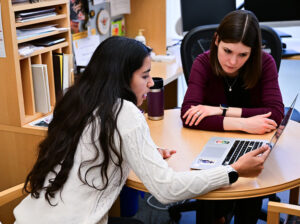
Méndez and Long met regularly to discuss the progress of her research.
Next, Méndez analyzed publicly available data from a Chilean household time-use survey. She found that people who spent more time caring were less satisfied with their lives and had less time for leisure activities such as meeting with friends outside the home. Unfortunately, her data on women’s decision-making power had some limitations: The wording of the survey question could be interpreted as referencing grocery shopping (often done by women), so she took extra steps to find new ways to measure bargaining power within households.
“Igna’s research expands upon a rich literature on the gendered impacts of unpaid care work,” said Melanie Long, associate professor of economics and business economics at the College, who served as Méndez’s I.S. mentor. “Igna’s results could shape how hospitals see the costs and benefits of different surgeries. She also collected her own data, which offered insights that have never been available on this topic.”
When it came to analyzing data, Méndez gained important skills with stats from her Econometrics course. “Most of the jobs I’m applying for recommend knowing how to code data,” she said. “I had to record and clean my own I.S. data, and I use it every day to run regressions.” She’s also passing on these skills to peers as a teaching assistant. Méndez even helped a friend working on a psychology I.S. by suggesting she use dummy variables. Though their research is drastically different, they shared tips learned from mentors and turned in their studies together–in coordinating outfits. Next up, Méndez will complete Boston University’s quantitative economics master’s program.
Before her turn-in, Méndez presented her research at an undergraduate session of the Eastern Economic Association Conference in February. “Presenting at Easterns requires students to move along at a very accelerated pace, so it is doubly impressive that Igna has been able to submit to the conference while undertaking such an ambitious project,” boasted Long.
“The thing that excites me the most about my I.S. is that it’s a real problem,” said Méndez. “It’s happening now, so we should solve it now.”
Featured image: Ignacia Méndez ’25, an economics major, analyzes gender inequality in relation to surgery recovery through her Independent Study.
This story originally appeared in the summer 2025 issue of Wooster magazine.
Posted in Independent Study, Magazine on June 23, 2025.
Related Posts


Related Areas of Study
Economics
Learn how humans organize to sustain life and enhance its quality from a diversity of economic perspectives
Major Minor