

Psychology professor Meredith Hope documents Black undergraduate women’s perceptions of institutional religious and spiritual support
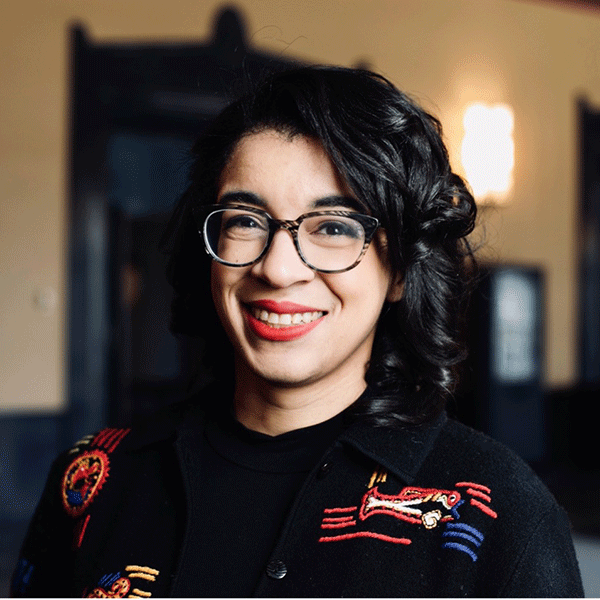
Meredith Hope, developmental psychologist and assistant professor of psychology at The College of Wooster, recently published an article in The Journal of Higher Education that is the first to explore Black undergraduate women’s perceptions of religious and spiritual resources at selective liberal arts colleges (SLACs).
“Religion and spirituality are often understudied and overlooked dimensions of culture,” Hope said. “College can often be the setting in which emerging adults are re-evaluating previously held beliefs, continuing in a faith tradition, or exploring new ways to believe or make meaning.”
This is the second paper from the Black@SLAC Study, which was funded through grants from the Society of the Scientific Study of Religion, Division 36 of the American Psychological Association, and the Society for the Study of Emerging Adulthood. The ethnically and religiously diverse sample consisted of 21 women of African descent attending 16 liberal arts institutions in the U.S. during the 2021-2022 academic year. Alyssa Clark, Walter D. Foss distinguished Visiting Professor of Psychology at the College co-authored with Hope on this project, alongside Alesha Archil, an undergraduate at Swarthmore College, and Gordon Palmer, assistant professor of educational policy studies at the University of Illinois-Chicago.
After analyzing data from semi-structured interviews, Hope and her colleagues’ research suggests that existing affinity groups and organizations may prioritize faith traditions associated with majority faith groups and/or majority cultural groups, which may discourage Black undergraduates from being involved.
Hope’s analyses yielded five themes: religious campus climate, institutional resources, increasing religious inclusivity, commitment to religious awareness, and supportive relationships. “The central theme in our article is that SLACs should engage in sustainable, long-term intersectional approaches to support Black undergraduates,” she said.
“Black women exhorted institutions to facilitate religious and spiritual inclusivity, campus-wide awareness and tolerance, and culturally affirming religious counter-spaces,” Hope added. She said each narrative “elucidated actionable changes for institutions to support Black women’s religious and spiritual lives and underscored recommendations for developing collectively sustainable and beneficial religious and spiritual climates.”
Hope said her team’s findings will extend the campus climate literature in higher education by emphasizing the intersections of racial, gender, and religious identity. “Given the heightened national focus on undergraduate retention, this study can offer evidence-based considerations and solutions to faculty, student affairs professionals, and other decision-makers in higher education,” she said.
At Wooster, Hope aims to work alongside her colleagues to “create and sustain academic spaces where students can envision, build, and maintain connections between their academics and their lived experiences.”
Posted in Faculty on March 31, 2026.
Related Posts


Related Areas of Study
Psychology
Do research, work with faculty mentors, and tailor a psychology program to your interests
Major Minor