

Biology major broadens animal knowledge with post-reproductive lifespan research in vertebrates
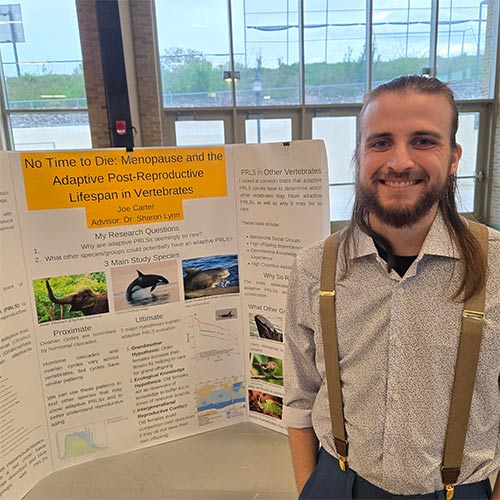
Joe Carter ’25 of Plainfield, Illinois, spent his time at The College of Wooster working as a teaching assistant and STEM Zone Intern, and participated in the Scot Symphonic Band and the horn choir. The biology major and music minor completed an Independent Study, “No Time to Die: Menopause and the Adaptive Post-Reproductive Lifespan in Vertebrates” that examined a rare trait and the small number of species/groups have it: humans, orcas, short-finned pilot whales, and potentially Asian elephants.
“My biggest love is the plants and animals we share this world with, so an opportunity to expand my knowledge on such a wide diversity of critters made my weekly work feel fresh and fun.”
—Joe Carter ’25
MY I.S.
Carter: Female killer whales live approximately 90 years and stop reproducing around 50. This period of life following reproductive senescence (the permanent end to reproductive cycling) is known as the post-reproductive lifespan (PRLS). My project looked at how and why reproductive senescence first evolved and why it continues to exist. There are only four described species in which PRLS is said to be adaptive, meaning it provides some sort of fitness benefit and individuals with this trait pass on more of their genetic information than those without. I did a non-traditional biology I.S. without any experimentation. Instead, I did a literature review of hundreds of sources to answer two major questions: why are adaptive post-reproductive lifespans seemingly so rare? and what other species/groups have an adaptive post-reproductive lifespan?
EXCITING ASPECTS
Carter: I.S. was a unique challenge that was entirely my own. The biggest excitement going into the project was that I could explore something that none of my other classes discussed, and something that none of my professors were experts in. I also learned about hundreds of unique animals. My biggest love is the plants and animals we share this world with, so an opportunity to expand my knowledge on such a wide diversity of critters made my weekly work feel fresh and fun.
EMPOWERED IN MY FIELD
Carter: STEM fields can be very intimidating and isolating at times, and I felt a huge amount of imposter syndrome going into this project. I felt wholly unqualified to write on this topic, and just getting started was one of the scariest parts for me. Another thing that scared me was my ability to ask good research questions. The more I read and the more I learned, the more I trusted my own capabilities and knowledge. I.S. really helped me address some of my own anxieties toward STEM and made me feel like I have what it takes to succeed in a career in any research field.
SUPPORTIVE SCOT COMMUNITY
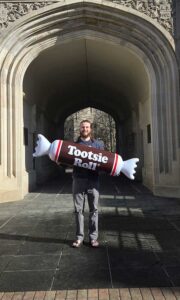
Carter poses for photos with the inflatable tootsie roll outside of Kauke Hall. Photo courtesy Joe Carter.
Carter: My biggest support system throughout the whole I.S. process was my advisor, Dr. Sharon Lynn. Each week, we met one-on-one to go over what I accomplished throughout that week. She helped me realize that working on a project like this has ups and downs. It’s all part of a cycle where the ups lead to the downs and the downs fuel the ups. This really helped me to not spiral and worry too much that I was falling behind, and it’s something that I’ll carry with me in the future.
MY TAKEAWAYS
Carter: I.S. made me confident in my ability to exist as an adult in the world, and it taught me how to be a better communicator. I’ve always struggled to communicate scientific information, and I hadn’t presented much of my own research prior to this process. While my professors didn’t have extensive knowledge in my topic, many were instrumental in getting me to fully explain my statements and really dissect how I came to my conclusions. I feel so much more confident now in my ability to communicate difficult information in an accessible way. As an underclassman, I felt like the goal of I.S. was to make an amazing project, but now I know that’s not the case. The point of I.S. is to teach you how to rely on yourself and to understand how you operate. I feel like I understand myself so much better after completing this project, and I feel more ready for the challenges that will come next.
CELEBRATION!
Carter: I didn’t do too much to celebrate turning in my I.S., but I did go see a lot of my friends turn in their projects. It left me with a feeling that’s indescribable. Seeing people supporting each other and witnessing the joy and relief of completing something that they’ve put so much time and effort into is priceless. The energy on campus on I.S. Monday is electrifying and inspiring.
WHAT’S NEXT
Carter: I am moving up to Fairbanks, Alaska, where I’ll be working as a lead field technician for the National Ecological Observatory Network (NEON Program). Eventually, I want to go back to school and pursue more of a conservation and advocacy role through land management practices.
Featured image: Joe Carter ’25 with his I.S. Symposium poster.
Posted in Independent Study on June 26, 2025.
Related Posts
Related Areas of Study
Music
Earn a bachelor of arts in music or a bachelor of music in either music performance or music composition
Major MinorBiology
Explore molecular and cellular biology, ecology and more with top faculty and access to extensive lab facilities.
Major Minor