

Wooster team of coauthors publishes study supporting control of mosquito-borne illnesses

Summertime equals mosquito-time in many parts of the world, and in some areas, bites become more than an itchy nuisance by additionally transmitting deadly diseases. For many of these diseases, there are no effective, accessible vaccines or cures, and the spread of the disease depends on controlling the mosquitos transmitting them. While effective, insecticides can kill beneficial insects and lead to insecticide resistance. New research from The College of Wooster takes an important step toward an alternative control method that uses mosquitos’ reproductive biology against them.
Laura Sirot, professor of biology at The College of Wooster, and Ferdinand Nanfack-Minkeu, assistant professor of Biology at Wooster, recently published the results of a long-term study analyzing the function of a hormone within mosquito reproductive biology in the journal Insect Biochemistry and Molecular Biology. The article, “Seminal fluid adipokinetic hormone increases insemination refractoriness in female Aedes aegypti,” also includes five Wooster alumni co-authors, who supported the research as students and William Reid of State University of New York at Buffalo. Their research shows how a hormone impacts female mosquito reproduction, results that could, long-term, contribute to more effective control of dangerous mosquito-borne illnesses.
Sirot’s research has centered on reproductive biology in mosquitoes for many years, and, in particular, on the Aedes aegypti mosquito, a mosquito known for being the primary transmitter for dengue, Zika, and chikungunya viruses. At Wooster, Sirot collaborates with students who contribute to the research, many of whom do so through their senior Independent Study research projects. “Research from five different students contributed to groundbreaking research that we’re able to highlight in this publication,” said Sirot. “A student’s curiosity, Gemma’s curiosity, in wanting to learn to use this really cool new microscope when Williams Hall opened in 2018, led to a unique discovery that AKH in mosquito’s seminal fluid seemed to impact female remating behavior.”
Alumna Gemma Briggs ’20, a neuroscience major who used a new confocal microscope in her I.S., was one of five students named as coauthors, including, Dhwani Parsana ’21, neuroscience major; Anna McGlade ’17, biochemistry and molecular biology; Meghan Wright ’22, biology; and Jade Baek ’23, neuroscience.
Sirot’s lab first discovered AKH, adipokinetic hormone, in the seminal fluid of a related mosquito, Aedes albopictus in a 2014 study. “Finding this protein, one of the most well-studied insect neuropeptides, in the seminal fluid is especially significant,” Sirot said, noting the lab’s in-depth study of the hormone and its proteins. “The hormone is normally made in glands around the brain, and we discovered that it’s made much more in the reproductive glands than it is in the brain.”
Discovering AKH in the seminal fluid led Sirot to apply for and receive a $325,000 grant from the National Institutes of Health (NIH) focused on growing young scientists, giving Wooster students the opportunity to be a part of research that contributes to understanding how to reduce the transmission of dangerous diseases through mosquitoes. Parsana, now a doctoral student at Case Western Reserve University, credits Sirot’s laboratory with her introduction to scientific research.
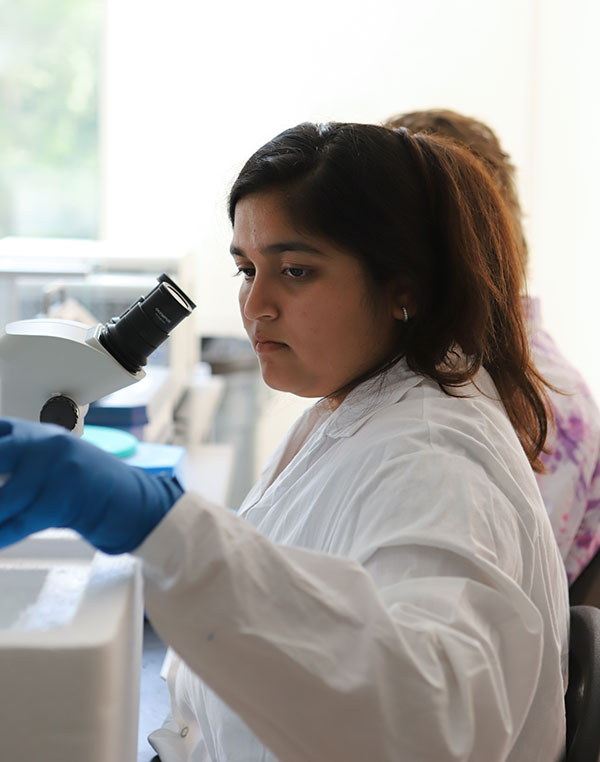
Dhwani Parsana ’21, neuroscience major, credits Sirot’s laboratory with her introduction to scientific research, allowing her to study real-world applications for understanding mosquito reproductive biology.
“I was introduced to the knowledge to tackle unanswered questions in the biological world,” Parsana said. “Dr. Sirot was very patient with teaching me how to conduct scientific research and think like a scientist.”
Understanding mosquito reproductive biology has real-world applications that inspire student I.S. research. In areas where mosquito-borne illnesses are public health concerns, reducing the population of these mosquitoes without damaging the surrounding ecosystem acts as a powerful tool.
The findings published in the new study focus on research from Sirot’s lab centering on the effects of AKH from male seminal fluid on female remating behavior. The results of this collection of studies highlighted in the publication lay the groundwork for understanding the evolution and effects of seminal fluid proteins as well as further investigation of new approaches to controlling the mosquito population. “Our research is the first to identify a protein that impacts the long-term mating behavior of these mosquitoes,” Sirot added.
Baek, now studying a Ph.D. in biomedical engineering at the University of Houston, noted that at Wooster even as she focused on the research trajectory set for the lab, Sirot’s guidance helped her recognize when something she noticed in the data was worth pursuing further. “My student-faculty research experience at Wooster taught me that scientific discovery can happen outside a researcher’s focus, highlighting how important it is to approach science with open-mindedness and curiosity,” Baek said.
Through further collaboration with a consortium of scientists in the International Atomic Energy Agency, an independent intergovernmental agency in the United Nations system, Sirot’s research alongside Wooster students, continues to inform reproductive biological solutions to the challenges of mosquito-borne illnesses.
Featured image: Laura Sirot, professor of biology at The College of Wooster
Posted in Faculty, News on July 17, 2026.
Related Posts


Related Areas of Study
Neuroscience
Psychology, chemistry, philosophy, computer science, and other disciplines combine in the study of the nervous system
MajorBiology
Explore molecular and cellular biology, ecology and more with top faculty and access to extensive lab facilities.
Major MinorBiochemistry & Molecular Biology
Biology and Chemistry combine in an interdisciplinary program for students with a passion for molecular events.
Major