
Wooster education professors harness AI to enhance teacher candidate preparation
After co-authoring several publications about how generative AI is an essential tool for preparing to teach in preschool through 12th grade (P-12) classrooms, education faculty at The College of Wooster
teamed up again to present at the Society for Information Technology and Teacher Education (SITE) 2026 International Conference. Their latest presentation focused on using AI chatbots as an element of reflective practice in teacher education. Megan Wereley ’94, associate professor of education, Ryan Ozar, assistant professor of education, and Matthew Broda, Ruth W. and A. Morris Williams Jr. Endowed Associate Professor of Education, are exploring how they might capitalize the learning value of chatbot configurations to allow their students (teacher candidates) to better understand the impact of their pedagogical choices.
“The nature of scholarly work with AI is very collaborative, and the pace moves quickly,” said Wereley. “There’s a tremendous amount of interest and lots of discourse about strategies for using it.” The trio’s first three publications focused on how AI significantly reduces the time investment for lesson planning and curriculum development where teachers are compiling structured ideas to address specific skills and meet requirements. AI also substantially increases personalization of the materials used to present lessons. Because of these benefits, Wereley and Ozar encourage teacher candidates to use AI to help create leveled reading passages (the same passage adjusted for different ability levels), design detailed rubrics, or establish behavior intervention plans, among other materials.
“The teacher is still the driver, but AI gives them another tool to think about how to personalize learning for P-12 learners,” said Wereley. Ozar added, “AI shines a light on how important it is to be good at human-based work. You can get really good materials, but to be really good, you have to be a human that can execute these lessons.”
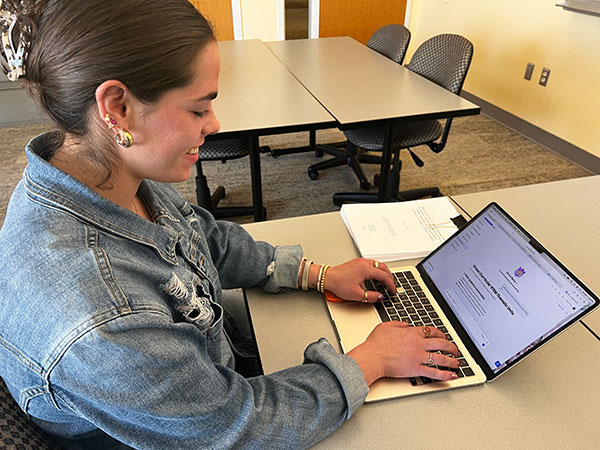
Julia Struck ’26, a senior in the primary (PK-5) licensure track, uses Magic School (an AI platform used by teachers for lesson planning) to create a lesson plan she used for teaching preschoolers as part of her senior I.S.
That’s where the chatbot exploration comes in. Teacher candidates can practice executing their lessons in simulations with rule-based chatbots. The chatbots act as conversational partners that respond to prompts and help teacher candidates think through lesson planning or teaching decisions.
In Wooster’s Build-A-Bot Configuration Project, preservice teachers design and configure an AI chatbot to support a specific learning goal designed for their students. They define the instructional context, learner needs, and learning goals. Then they’ll develop instructions (configuration models) for their chatbot that drive how it will explain concepts, respond to confusion, and scaffold student thinking without simply giving answers. “By embedding these decisions into the bot’s behavior, our teacher candidates will translate their pedagogical beliefs into concrete instructional choices,” explained Wereley. They’ll have opportunities to revise the bot as a way of reflecting on their teaching assumptions after simulated student interactions.
Another chatbot, designed by Broda, generates simulated classroom management scenarios across a range of grade levels and content areas. Wooster students are presented with a situation that requires them to determine how they would respond as the teacher. After proposing a strategy and explaining their rationale, the chatbot provides feedback that highlights strengths in their thinking while also raising possible concerns or alternative approaches to consider. Then at the end, the chatbot provides a summary of the teacher candidate’s key strengths in managing the situation along with suggestions for continued growth.
While chatbots give teacher candidates initial feedback, Wereley emphasized that, “It’s important for the AI strategies and conversations to be happening among researchers, administrators, and practitioners simultaneously about how theoretical ideas are actually experienced when they are operationalized in the classroom,” said Wereley. “The ideas need to be experienced among real kids in real classrooms to see what works best.”
The trio said they’ll continue to learn more about agentic AI and consider how it will start to replace textbooks or even operate alongside paraprofessionals in the classroom, as well as what that means for the field. Several members of the education department will also lead an Alumni College session at Wooster’s upcoming Reunion Weekend called “Don’t Panic (but maybe learn to prompt)!” to share how Wooster is preparing teachers for the age of artificial intelligence. Presenting faculty include Wereley and Broda, along with Sarah Dunlap, director of field assessment and candidate engagement, Allison Neptune ’05, visiting assistant professor of education, and Gretchen Tefs, visiting instructor of education.
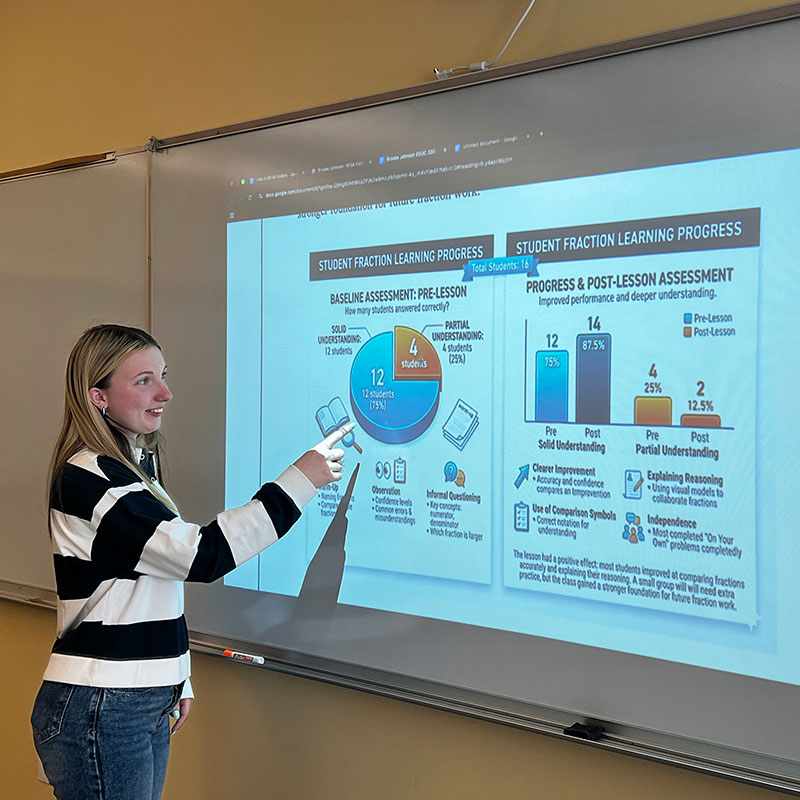
Featured image: Brooke Johnson ’27, a junior in the primary (PK-5) licensure track presents pre/post assessment data she generated as part of her final project for a Curriculum Methods and Assessment in Primary (P-5) Education course where she taught a series of lessons and measured their impact on student learning.
Posted in News on May 12, 2026.
Related Posts


Related Areas of Study
Education
Graduate as a licensed teacher in pre-K-12 in fields ranging from science to music education
Major Minor Teaching Licensure