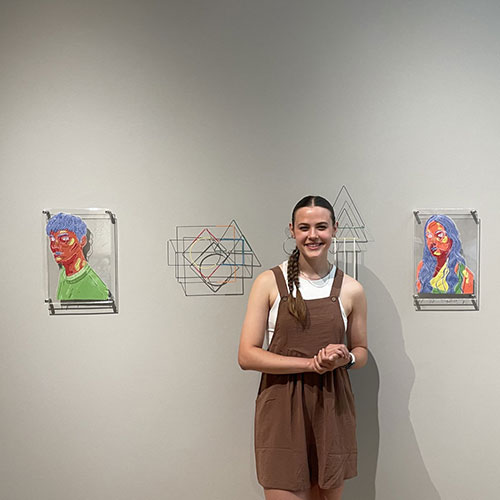
Studio art major explores family dynamics through senior exhibit
Majoring in studio art and minoring in education at The College of Wooster, Adele Dooner ’25 discovered the Kandinsky Color Test that correlated primary […]
Wooster students graduate fully licensed to teach in Ohio (and are prepared to transfer their licensure to other states). They also graduate with hundreds of hours of classroom experience and lessons learned from their partnerships with teacher mentors, but what makes Wooster education majors sought after by employers is their ability to teach from a liberal arts perspective. Wooster students are critical thinkers; they dig into research and enjoy the curiosity and debate that elevate classroom teaching. Wooster students who become teachers treat their new classrooms like College of Wooster classrooms: robust learning environments. All students at The College of Wooster complete an independent study under the guidance of a faculty mentor. Education graduates from Wooster bring the rigor of independent study to their K-12 classrooms, giving a new generation of learners the benefi ts of a liberal arts perspective.
The Education major is completed along with a second major in a chosen content area. Students wishing to major in Elementary/Primary Education (PK-5) may double major in any other major offered by the college. Students interested in middle and high school grade levels (7-12) will major in Education with a second major in a specifi ed academic discipline appropriate to the associated licensure area. Upon graduation, students following this course of study will have completed a double major and earned an Ohio initial, two-year Resident Educator teaching license, making them fully licensed to teach in the State of Ohio. Many of our graduates successfully transfer their licenses to other states. The education minor is an option for students interested in education and working with children, but it does not lead to teacher licensure.
The College of Wooster Department of Education is accredited by the Council for the Accreditation of Educator Preparation (CAEP) for initial programs through Fall 2030. The College of Wooster’s licensure programs are all approved by the Ohio Department of Education. (ODHE).
The following initial licensure programs were included in the Spring 2025 Site Visit and are fully accredited by CAEP:

Ruth W. and A. Morris Williams, Jr. Endowed Associate Professor and Department Chair of Education

Director of Field, Assessment and Candidate Engagement of Education



Administrative Coordinator, Notary Public - Economics and Business Economics, Education, Psychology


Majoring in studio art and minoring in education at The College of Wooster, Adele Dooner ’25 discovered the Kandinsky Color Test that correlated primary […]
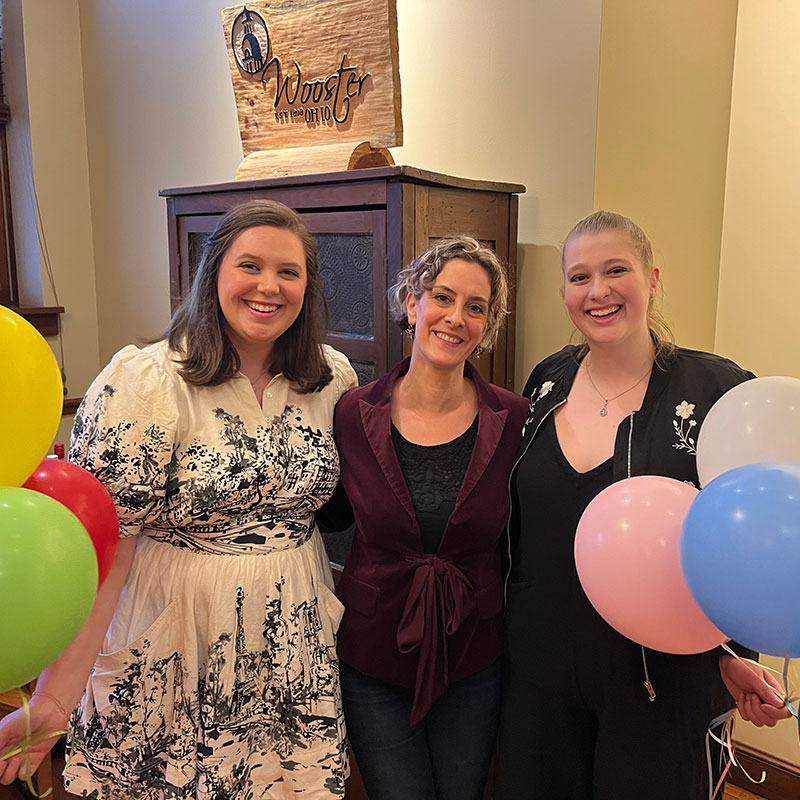
Two 2025 graduates from The College of Wooster were chosen for the Teaching Assistant Program in France (TAPIF) cohort for the upcoming academic year. […]

Mallory Band ’14 was diagnosed with ADHD and anxiety when she was 8 years old. For her, it impacts every part of her life, […]
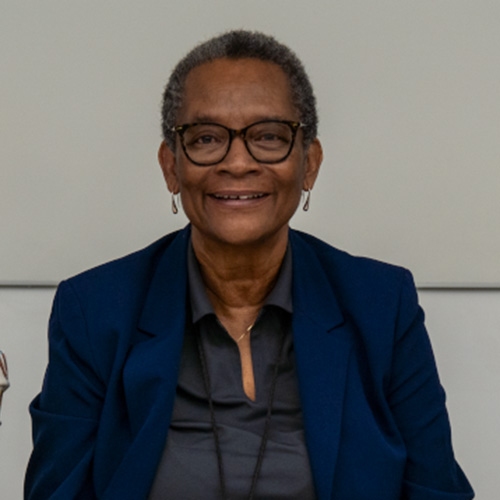
When Alpha Alexander ’76 was a student athlete at The College of Wooster, she was one of the few Black women on her teams. […]
The College of Wooster is a CAEP accredited institution. Students who complete the Education major are fully licensed to teach in the state of Ohio. Those who plan to teach elsewhere find that Ohio’s high standards for licensure provide them with a sound preparation for teaching and also allow them to pursue licensure in other states with relative ease.
Wooster students graduate with no less than 700 hours of experience in the classroom. A hallmark of Wooster’s Education major is its partnerships with area educators and schools and its emphasis on field and clinical experiences. Throughout the Education major and licensure process, students are immersed in hands-on, experiential education in area classrooms and schools both before and during the student teaching experience. These activities allow teacher candidates to authentically experience the profession by providing them with opportunities to actively participate in P-12 classrooms. This weaving of theory and practice promotes on-going professional development and prepares teacher candidates effectively for Student Teaching and future teaching experiences.
View CoursesThe minor in Education consists of six courses, beginning with Introduction to Education and continuing with five courses from a list that includes education, sociology and psychology.
View CoursesAll students at The College of Wooster complete two semesters of independent study under the guidance of a faculty mentor. I.S. projects are delivered as a thesis in the spring of each student’s senior year.
| Student | Year | I.S. Title | Major 1 | Major 2 | Advisor |
|---|---|---|---|---|---|
| Please search to view results | |||||
Areas of Teacher Licensure
Wooster offers programs for teaching licensure in the following areas:
Graduates of Wooster’s Teacher Education program pursue a variety of professional opportunities.
While many teach in traditional public and private schools, graduates also contribute to the education profession in other ways. In addition to teaching, Wooster alumni are employed as school administrators, school counselors, athletic coaches, intervention specialists, school psychologists, speech-language pathologists and higher education faculty.
We also recognize the importance of supporting students interested in alternative teaching opportunities such as Teach For America, charter schools, Teaching Fellows, Urban Teachers, City Year, etc.
CAEP ACCOUNTABILITY MEASURES (CAEP COMPONENTS 5.4)
CAEP regularly monitors how each Educator Preparation Program (EPP) updates and publicly reports on completer effectiveness and impact, employer satisfaction, stakeholder involvement, candidate competency at program completion, and the ability of completers to be hired for education positions for which they have been prepared on its website. This addresses the EPP’s continued effort to share widely, completer impact and outcomes data. EPPs are responsible for clearly identifying and prominently displaying data on each Accountability Measure on their websites so that the information is easily visible and accessible to the public.
Measure 1: Completer Impact and Effectiveness (R4.1)
Completer impact in contributing to P-12 student learning-growth AND completer effectiveness in applying professional knowledge, skills, and dispositions.
Measure 2: Satisfaction of Employers and Stakeholder Involvement (R4.2|R5.3)
Satisfaction of Employers
Our EPP administers the Perceptions of EPPs Survey, and the data is collected and shared with the EPP. In 2016, the Ohio Department of Higher Education (ODHE) developed a valid survey instrument and administered it statewide to Educator Preparation Programs (EPPs). Initially, due to low response rates when surveys were sent via mail or email, EPPs began administering the Employer Survey independently. In response to these challenges, Ohio University implemented a transformative practice in the Fall of 2023, shifting to conducting face-to-face interviews with employers. This approach involves completing the survey with employers before the conclusion of each meeting, ensuring immediate and complete data collection.
Stakeholder Involvement
The EPP includes internal (e.g., COW faculty and staff, EPP faculty and staff, candidates) and external (e.g., school and community partners, employers, alumni, practitioners) stakeholders in program design, evaluation, and continuous improvement.
EPP Faculty and Staff
EPP faculty and staff are integral to the effectiveness of the QAS. Program faculty engage in regular course and department discussions on candidate performance and curriculum, and are responsible for completing candidate evaluations on key assessments as part of the QAS. Additionally, faculty serve on committees related to curriculum, planning, research, and technology within the college. All faculty and staff in the EPP participate in internal and external advisory meetings two times a year and contribute to and discuss recommendations for program improvements.
Internal Stakeholders
The internal advisory board meeting focused on the Department of Education’s performance and future plans. Key metrics included 71 declared majors, 25% non-white students, and a gender breakdown aligning with school demographics. Upcoming student teacher numbers were 17 in the spring and 13 in the fall of 2025, with expanding locations including Minneapolis and Pittsburgh. New programs under consideration include science education, intervention specialists, and computer science endorsement. The department is also adapting to a pre-K through 8th-grade licensure by 2027. The meeting also covered accreditation preparation, data analysis, and employer feedback mechanisms to ensure program relevance and student success.
External Stakeholders
The External Advisory Board, comprised of members from our EPP, PK-12 teachers, administrators, and community partners, meets twice a year to work together on program design, evaluation, and continuous improvement. The diverse group of stakeholders reflects our commitment to adaptability and relevance in the evolving landscape of education. Members are thoughtfully selected to address current needs and challenges facing our program, ensuring that our strategies and initiatives are deeply informed by a broad spectrum of professional expertise and practical experience. Through this collaboration, our work focuses on continuous improvement that impacts our teacher preparation, fostering a responsive educational team.
Faculty from the education program met with regional school and career center partners to gather feedback on emerging issues in educational technology and teacher preparation. The conversation focused on how schools are responding to recent policy changes, new digital tools, and evolving expectations for teachers entering the profession. Participants shared insights from their districts to help the program strengthen its preparation of future educators to use technology thoughtfully, ethically, and effectively in classrooms.
A significant portion of the discussion centered on Ohio Senate Bill 29, which introduces new requirements related to student data privacy, cybersecurity, and the management of educational technology vendors. School partners described how districts are working to ensure that technology platforms comply with updated privacy standards and how these changes may influence classroom technology use. Participants noted that preservice teachers should be prepared to navigate these regulations by consulting district guidelines, using approved tools, and understanding how privacy considerations shape technology decisions in schools.
The group also discussed the growing role of artificial intelligence and digital learning tools in K–12 education. Partners emphasized the importance of helping future teachers evaluate emerging technologies, integrate them responsibly into instruction, and guide students in using these tools ethically. In addition, participants reviewed the program’s technology integration rubric and provided suggestions for strengthening how teacher candidates learn to make developmentally appropriate technology choices and design authentic learning experiences.
The meeting concluded with ideas for expanding partnerships with local schools to give teacher candidates more opportunities to observe and learn from effective technology practices in real classrooms.
Measure 3: Candidate Competency of Program Completion (R3.3|R3.4)
Title II Section 207 of the Higher Education Act (HEA) requires states, as recipients of HEA funds, and all institutions with teacher preparation programs that enroll students receiving federal financial assistance, to prepare annual reports on teacher preparation and licensing. The reports detail the enrollment and completion of our candidates.
College of Wooster graduates exceed the mean scores required for their licensure exams. Measures of competency at completion include demonstrated mastery of planning, teaching, and assessment for all candidates.
Measure 4: Ability of Completers to be Hired in Education Positions for Which They Have Been Prepared
The data gathered is related to completers’ employment in teaching positions for which they were prepared in years one and two after graduation. Several of our completers teach outside of Ohio after graduation; therefore, we rely on the EPP-gathered data based on individual responses.