Four archeology students share I.S. research journey in Guatemala
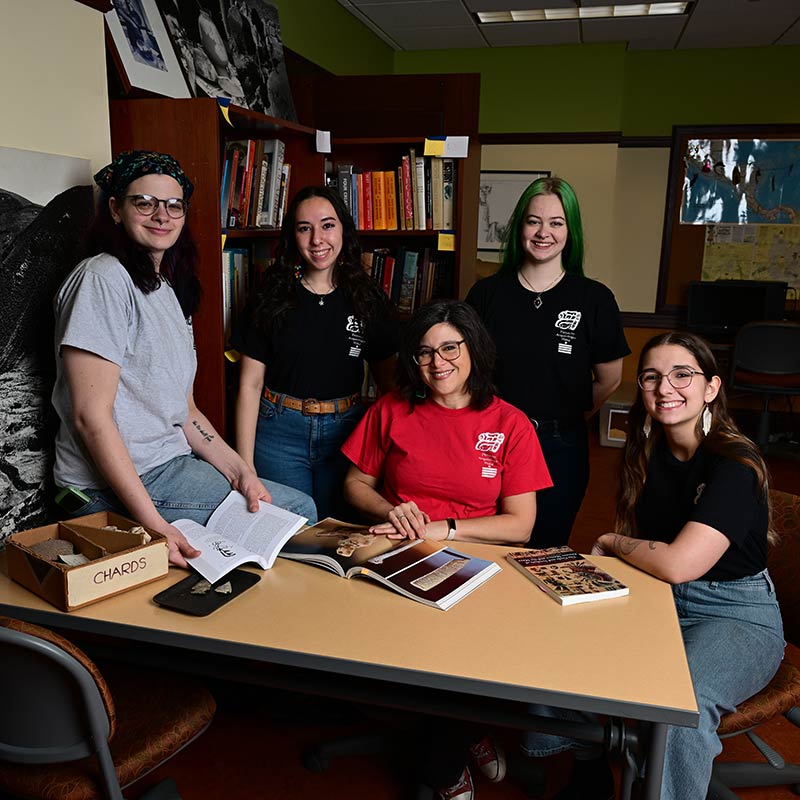
In more than 20 years of archaeological research with Proyecto Arqueológico Waka’ (PAW), Olivia Navarro-Farr, professor of anthropology and archaeology and chair of archaeology at The College of Wooster, has taken many students to the site to train them on how to conduct archaeological research. During the 2024 summer, four students traveled to Guatemala with Navarro-Farr for an archaeology TREK (short for Think, Research, Engage, Know, an off-campus learning program). The shared experience was an impactful one for Sydney Berenson ’25, Maura Ellenberger ’25, Teagan Knutson ’25, and Des Smith ’25, who also pursued Independent Study topics intertwined by their travels and research.
“As a project director who’s also working in a teaching institution, I have a really important opportunity to engage with and direct students to primary research,” said Navarro-Farr, a founding member and co-director of PAW since 2017. “It’s essentially graduate-level research for undergraduate students.”
A collaboration between Guatemalan and American researchers, PAW focuses on the El Perú-Waka’ archaeological site, an ancestral Maya city that was once a thriving center of trade and political interaction. Navarro-Farr and the PAW team continue to make discoveries that add to historical understandings of the Early (about C.E. 250-550) and Late (about C.E. 550/600-800/850) Classic periods of ancient Maya civilization.
The TREK kicked off with two weeks at the site located in the Laguna del Tigre National Park within the Maya Biosphere Reserve. “I learned archaeological field techniques like test pit excavations and architectural drawing and walked the history of El Perú-Waka’,” said Berenson. The last week of the TREK included exploration at important cultural sites in Flores, Antigua, and Tikal such as museums, a coffee farm, markets, shrines, and more.
Berenson, Knutson, and Smith then spent six additional weeks working in the project’s lab house in San Lucas conducting ceramic analysis of the 2022 field season archaeological material through APEX Fellowships. Henry McMahon ’24, who completed his I.S. based on research at the site, returned in summer 2024 as well and acted like another “built-in mentor,” Smith said. They washed, sorted, weighed, and recorded large quantities of ceramic artifacts, reassembled vessels, and learned to photograph and draw ceramic fragments for archaeological publication. These analysis efforts help the team establish a chronological timeline for the archaeological site of El Perú-Waka’ and the students became coauthors in a jointly published report submitted by the PAW team to the Guatemala’s Ministry of Culture for review. At the annual Symposium for Archaeological Investigations in Guatemala, students also networked with many professional archaeologists from other sites across the region.
The self-proclaimed “TREKkies” became close after the summer and often ended up writing together in the archaeology lab as they shifted their focus to I.S. or studying for Navarro-Farr’s Mesoamerican Art and Iconography class in their senior year. “Archaeology is collaborative work, so while we each might not have been doing the exact same thing for the same amount of time, our strengths and efforts all culminated into the same end goal,” said Smith. “It’s really beautiful if you think about it, and I love that aspect of our work.”
All four students took what they learned on site and turned it into their own I.S. projects, with Navarro-Farr serving as their mentor. “Maura and I focus on the contemporary effects of archaeology, while Teagan and Des explore iconography,” said Berenson. “Each of our projects differs, but there’s a beautiful sense of interconnectedness that mirrors the Maya worldview.”
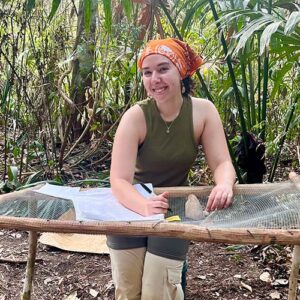
Sydney Berenson ’25 completed an APEX Fellowship in Guatemala in summer 2024, conducting ceramic analysis on Maya artifacts from El-Perú Waka’. Photo provided by Berenson.
Berenson, an archaeology major, found a meaningful way to combine her major with Spanish and museum studies minors into a cohesive study that centered on the ethics around remnants of Stela 34, a carved stone monument that was looted from El Perú-Waka’ in the 1960s. She learned that the upper register ended up at the Cleveland Museum of Art an hour North of Wooster. “I hope that my project will eventually lead to or encourage communications between PAW and the museum for potential plans for the photogrammetric scanning of Stela 34, and maybe even potential repatriation efforts in the future,” said Berenson. Her APEX Fellowship in summer 2024 built off this research.
Also majoring in archaeology, Ellenberger worked on the College’s Pella Project led by Beth Derderian, assistant professor of anthropology and museum studies, to help bring new life and visibility to an orphaned collection of ancient artifacts from an excavation in Pella, Jordan. It made her think more about the process behind the projects, beyond the data that they produce. This spark and her plans to study library and archival sciences in graduate school led her to study the ethics of how archaeological projects get funded. She focused on two U.S.-led projects in Guatemala and relied heavily on archival documents and interviews for information. “Funding is a complicated subject, especially when considering the full picture of what shapes archaeological projects with politics, site location, and nationalism,” said Ellenberger.
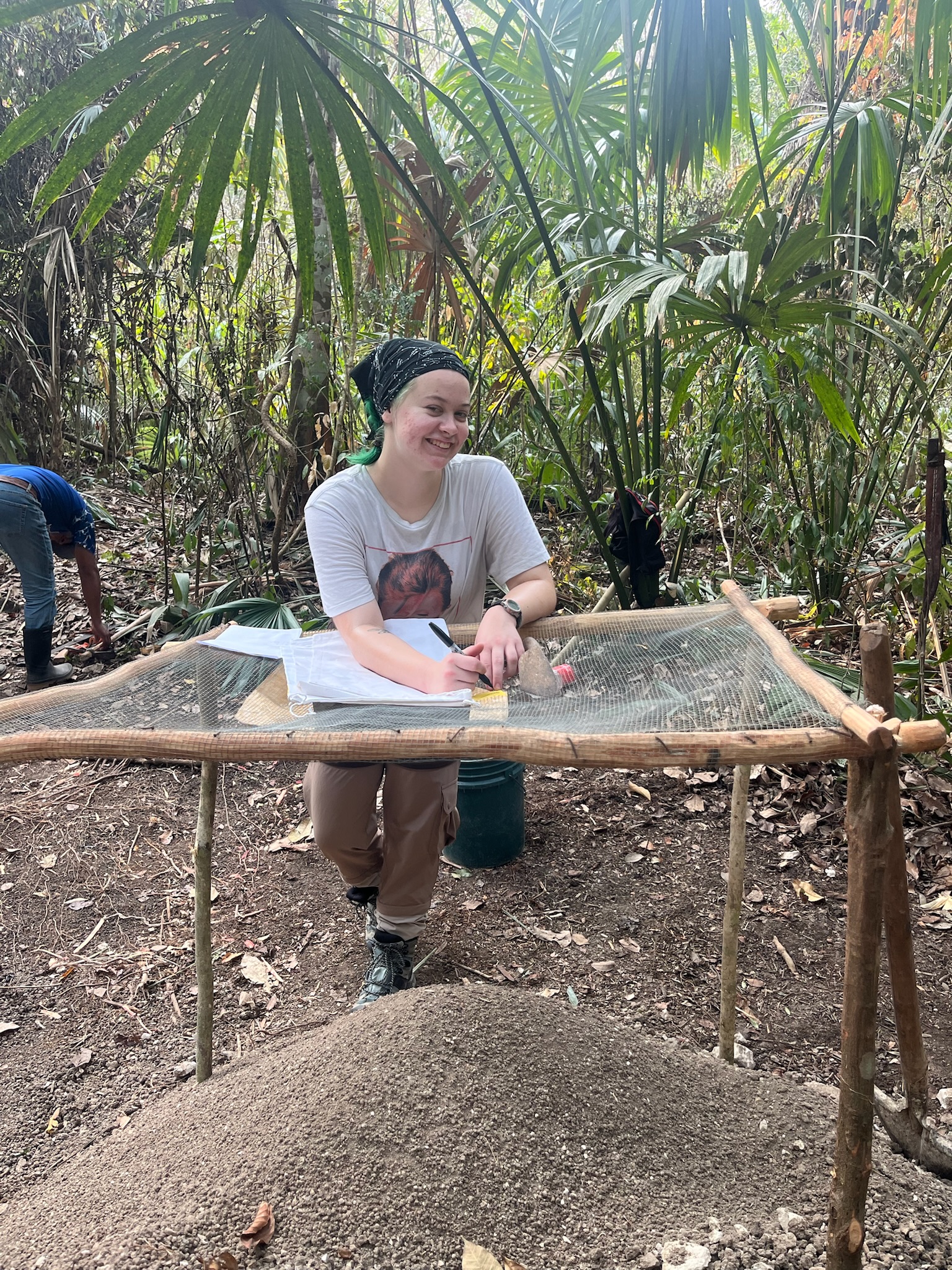
Teagan Knutson ’25 completed a summer 2024 APEX Fellowship in Guatemala, where she learned about ceramic analysis and site excavation. Photo provided by Knutson.
Knutson explained her iconographic study of a vessel from Burial 61 is more theoretical than the others. With majors in archaeology and religious studies, she worked with both Navarro-Farr and Sarah Mirza, associate professor of religious studies, to satisfy the dual requirements. Navarro-Farr excavated this burial in 2012, and the team discovered it belonged to Lady K’abel, one of the site’s most famous royal queens who co-ruled the city during the Late Classic period. Knutson’s previous APEX Fellowship in summer 2024 gave her the prior knowledge to continue her research on El-Perú Waka’.
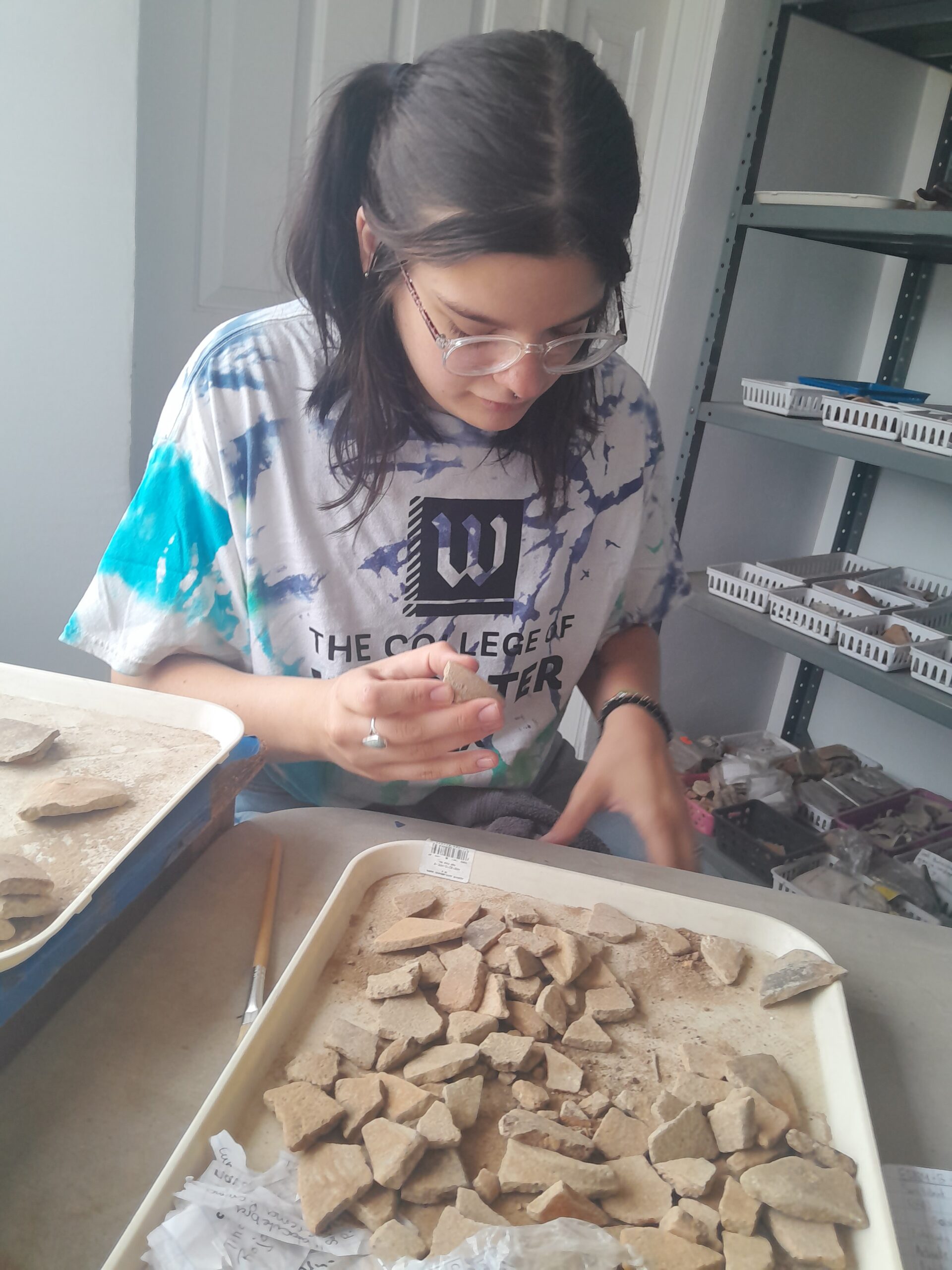
Des Smith ’25 worked in a lab located in San Lucas, Guatemala with artifacts from El-Perú Waka’ for her APEX Fellowship. Photo provided by Smith.
Tying together her archaeology and environmental geoscience majors, Smith focused her research on a stone figurine that was also unearthed within Lady K’abel’s tomb. She hoped to link the figurine to caves and cave stones for a geosciences angle. “That didn’t go as planned, but I still gathered important data about surficial contamination and treatment,” said Smith, who developed a more nuanced understanding of culturally respectful and ethical research. Similar to Berenson and Knutson, Smith completed a 2024 APEX Fellowship. Located at San Lucas Sacatepequez, Guatemala, she was able to take her travel and relate it to her I.S.
Navarro-Farr enjoyed watching her advisees explore their themes in unique ways. “They use distinct methodologies and different data sets but all to tell a richer story about objects, artifacts, and histories and perspective plans for the future,” she said. The shared experience was made possible with several funding sources from on and off campus, including the Henry A. and Louise F. Leander Endowed Fund, Kendall-Rives Endowed American Research Grant, and others. The three APEX Fellows returned to the site with Copeland funding in January 2025 to acquire more data for I.S., and Berenson and Knutson found their way back to Waka’ after graduation in summer 2025.
Navarro-Farr emphasized that she’s not working independently either—her Guatemalan colleagues and friends make these student experiences possible. “This is their country, and their perspectives are so important for students to learn from,” she said. “Global interaction isn’t just foreigners gazing at each other. It’s really getting to know people from the community and working alongside them. These students absolutely have done that, and it’s terrific to see.”
Berenson said her time in Guatemala and growing closer to the “TREKkies” and her advisor has been one of the most cherished and impactful experiences she’s had at Wooster. “This collaboration has deepened our connection to both the Maya culture we are studying and to each other as researchers. It’s a reminder that even though I.S. is often an individual pursuit, in this case, it has been a shared journey.”
Featured image: Des Smith ’25, Sydney Berenson ’25, Professor Olivia Navarro-Farr, Teagan Knutson ’25, and Maura Ellenberger ’25 reconnected on campus after researching together in Guatemala.
This story originally appeared in the summer 2025 issue of Wooster magazine.
Posted in Homepage Featured, Independent Study, Magazine on June 22, 2025.
Related Posts

Related Areas of Study
Religious Studies
An interdisciplinary, academic approach to the study of religion that includes history, art, theology, and more.
Major MinorEnvironmental Studies
Natural sciences, social sciences, and humanities courses combine for those who want to be part of environmental solutions
Major Minor