Lectures
The Helen Murray Free Endowed Lecture Series
 Helen Murray Free, a 1945 College of Wooster graduate and a pioneering scientist who was inducted into the National Inventor’s Hall of Fame in 2000, was honored with the inaugural Helen Murray Free Endowed Lecture, featuring Dr. Mary Lowe Good.
The lecture series was established by Helen’s children and endowed through the Al and Helen Free Foundation. Each year, this endowed fund brings a renowned chemical scientist to campus to interact with chemistry students at a technical level and present an all-college convocation on the contributions of science to the quality of life.
Free, whose research in clinical chemistry not only revolutionized diagnostic testing in the laboratory, but also in the home, developed the “dip-and-read” glucose tests for diabetics. She was awarded seven patents for her clinical diagnostic test inventions, and also helped to develop a product for diagnosing Hepatitis ‘A’ while working for Miles Laboratories. In addition, she provided invaluable leadership in the testing of newborn infants for genetic or metabolic disorders that might lead to mental retardation.
Throughout her career, Free has been an active advocate of science education. From 1987 to 1992, she chaired the American Chemical Society’s (ACS) National Chemistry Week Task Force. In 1980, she was chosen as one of Wooster’s Distinguished Alumni Award winners; in 1992 she received an honorary degree from Wooster; and in 1993 she was elected president of the American Chemical Society.
Free has authored more than 150 professional articles, and co-authored two widely used textbooks in the field. Her accomplishments have been recognized in a number of ways, including the awarding of the ACS Garvan Medal and the Professional Achievement Award in Nuclear Medicine from the American Society for Medical Technology, as well as the establishment of the ACS Helen M. Free Public Outreach Award.
Thursday, October 23, 2025
Gregory H. Robinson, Ph.D., FRSC, Foundation Distinguished, Professor of Chemistry, University of Georgia
Visit Robinson’s Website
Technical Lecture: “N-Heterocyclic Carbenes and Dithiolene Radicals: Counterintuitive Main Group Chemistry”
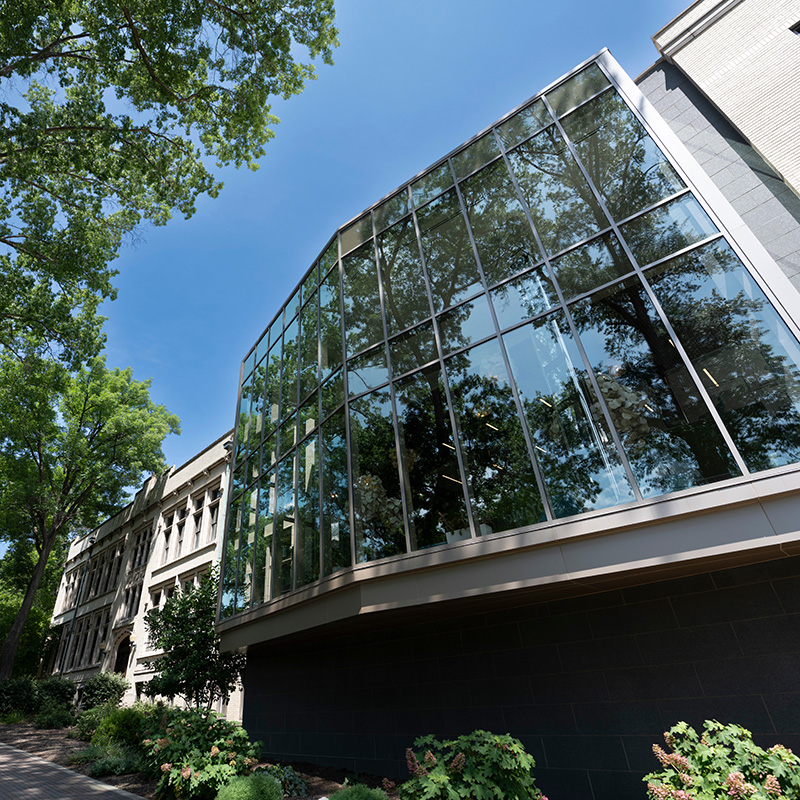
- 11:00 a.m. in Room 060, Ruth W. Williams Hall (931 College Mall)
The Robinson laboratory has long pursued the synthesis, structure, and reactivity of unusual molecules that prominently feature main group elements. These efforts resulted in several significant milestones including the experimental realization of “metalloaromaticity” (the concept that metallic rings may also display traditional aromatic behavior as exhibited by benzene), synthesis of the first molecule containing a boron-boron double bond—the first “diborene”, and synthesis of the first molecule containing a triple bond between two main group metals (the gallium analog of acetylene). Research efforts have also concerned carbene stabilization of highly reactive main group molecules such diphosphorus (P2), diarsenic (As2), and disilicon (Si2). This presentation will prominently feature the Robinson laboratory’s efforts to synthetically augment the molecular template of N-heterocyclic carbenes and their surprising conversion to stable dithiolene-based chemical radicals, which have shown promise in the activation of small molecules, such as ammonia.
Public lecture: “From Hydrogen to Radon: Playing the ‘Long Game’ in Inorganic Chemistry”
- 7:30 p.m., Room 060, Ruth W. Williams Hall (931 College Mall)
From the syntheses of the first molecules containing boron-boron double bonds—the first “diborenes”—to the first molecule shown to possess a triple bond between two main group metals—the first “gallyne”—a digallium analog of acetylene, the Robinson Laboratory has made noteworthy contributions to Inorganic Chemistry. Consequently, in addressing foundational issues of structure and bonding, fascinating new areas of chemistry have emerged from the Robinson laboratory such as metalloaromaticity (the realization that properly constrained metallic ring systems can display traditional aromatic properties, thereby mimicking the chemical behavior of benzene), multiple-bonding involving heavier main group elements, stabilization of silicon dioxide-based precursors to “molecular sand”, dithiolene-based aluminum tri-radicals. These discoveries will be summarized and placed in historical context. As history can attest, “change” is frequently disruptive.
Both lectures are free and open to the public.
Biography:
When Gregory H. Robinson, a native of Anniston, Alabama, was born (1958) the American South remained firmly in the throes of racial segregation. Consequently, he began his education by attending an underfunded, overcrowded racially segregated elementary school. Robinson obtained his B.S. in Chemistry (1980) from Jacksonville State University (Jacksonville, AL). While attending JSU, Robinson was also a four-year letterman on the Gamecock football team, earning All-Gulf South Conference and Gulf South Conference Defensive Player of the Year (1979). Attending graduate school at The University of Alabama and studying synthetic inorganic main group chemistry in the laboratory of Professor Jerry L. Atwood, Robinson received his Ph.D. (1984). After spending a decade on the faculty of Clemson University (South Carolina), Professor Robinson joined the faculty of The University of Georgia (1995) and now holds the title Foundation Distinguished Professor of Chemistry. Professor Robinson’s research, involving the synthesis, structure, and reactivity of unusual molecules of the main group elements, has been described as provocatively innovative. Research highlights include: (a) experimental realization of the concept of metalloaromaticity—that properly constrained metallic (gallium) ring systems can exhibit traditional aromatic behavior; (b) synthesis and molecular structure of the first compound containing a metal-metal triple-bond between two main group metals; (c) synthesis of the first compound containing a boron-boron double bond—the first “diborene; and (d) room temperature stabilization of highly reactive molecules such as disilicon, diphosphorus, and diarsenic. Professor Robinson’s peer-reviewed research articles, now numbering over 175, has been published in prestigious journals including Science, Nature Chemistry, the Journal of the American Chemical Society, and Organometallics. Professor Robinson has received numerous awards including the Humboldt Research Prize, the Southern Chemist Award, the F. Albert Cotton Award in Synthetic Inorganic Chemistry by the American Chemical Society, and the Lamar Dodd Award—the highest research award of The University of Georgia. Professor Robinson is a member of both the National Academy of Sciences (2021) and the American Academy of Arts and Sciences (2025).
Selected Awards:
Professor Robinson will receive the M. Frederick Hawthorne Award in Main Group Inorganic Chemistry at the National ACS Spring 2026 meeting in Atlanta, GA. Learn more about his work: https://www.gregoryhrobinson.com/
- American Academy of Arts and Sciences (elected in 2025)
- National Academy of Sciences (elected 2021)
- Fellow of the Royal Society of Chemistry (2017)
- F. Albert Cotton Award in Synthetic Inorganic Chemistry by the American Chemical Society (2013)
- Humboldt Research Prize (2012)
- Lamar Dodd Creative Research Award—the highest research award of The University of Georgia (2010)
- Southern Chemist Award (1998)
Past Lecturers
2024:
Dr. Tehshik Yoon, Professor of Chemistry, University of Wisconsin-Madison
- Technical Lecture: “Stereocontrol in Photochemical Reactions”
- Public lecture: “Radical Chemistry: A Case for LGBTQ+ Visibility in STEM”
2023:
Dr. Amanda Hargrove, Professor of Chemistry, Associate Professor of Biochemistry, Duke University
- Technical Lecture: “Modulating the conformation and function of disease-relevant RNA with small molecules”
- Public Lecture: “Shining light on hidden players in disease”
2023:
Dr. Rigoberto Hernandez, Gompf Family Professor, Department of Chemistry and Professor, Departments of Chemical and Biomolecular Engineering, and Materials Science and Engineering at Johns Hopkins University; Director, Open Chemistry Collaborative in Diversity Equity (OXIDE)
- Scientific Talk: “Spiral feedback between computation and experiment at the nano-bio interface”
- Public Lecture: “Managing Inclusive Excellence in Academia”
2021:
Raychelle Burks, associate professor of chemistry at American University and a popular science communicator who has appeared on TV, in podcasts, and at large genre cons such as DragonCon and GreekGirlCon
- Scientific Talk: llicit indications: colorimetric and fluorometric visualizations for forensic science
- Public lecture: Monsters, Murder, and Marvel
Malika Jeffries-EL, Ph.D. associate dean, Graduate School of Arts & Sciences, associate professor of chemistry and materials science and engineering, Boston University
- Scientific Talk: Design and synthesis of organic electronic materials
- Public lecture: Taking the Road Less Travelled: My Journey to the Ivory Tower
2020:
Geraldine (Geri) Richmond, Presidential Chair of Science and professor of chemistry, University of Oregon
- Technical Lecture: Surf, Sink or Swim: Understanding Environmentally Important Processes at Water Surfaces
- Public Lecture: The Importance of Global Scientific Engagement
2018:
Joseph S. Francisco, President’s Distinguished Professor, Department of Earth and Environmental Science, University of Pennsylvania
- Technical Lecture: From Atmospheric Complexes to Aerosols: New Insights into Atmospheric Chemistry
- Public Lecture: How We Can Rebuild Trust in Science— And Why We Must
2017:
Bassam Z. Shakhashiri,The William T. Evjue Distinguished Chair for the Wisconsin Idea, Department of Chemistry; Director, Wisconsin Initiative for Science Literacy, University of Wisconsin-Madison; President, the American Chemical Society, 2012.
- Technical Lecture: Science and Society: Our Opportunities and Responsibilities
- Public Lecture: Science Is Fun and The Joy of Learning
2016:
Madeleine Jacobs,President & CEO, Council of Scientific Society Presidents, Former Executive Director and Chief Executive Officer of the American Chemical Society.
- Morning Lecture: Ten Lessons of a Lifetime of Science
- Evening Lecture: The Two Cultures, Zen and the Art of Motorcycle Maintenance
2015:
Ned Heindel, H.S. Bunn Chair Professor of Chemistry at Lehigh University and a consultant on drug development for Azevan Pharmaceuticals.
2014:
Paul Anderson, Retired Senior Vice President of chemical and physical sciences for the DuPont-Merck Pharmaceuticals Company.
2013:
Susan Solomon, Ellen Swallow Richards Professor of Atmospheric Chemistry and Climate Science at Massachusetts Institute of Technology.
2012 Fall:
Sam Niedbala, Professor of practice in the Chemistry Department at Lehigh University and CEO of DeTect Biosciences LLC.
2012 Spring:
Catherine Hunt, R&D Director of Innovation Sourcing and Sustainable Technologies at The Dow Chemical Company.

 Helen Murray Free, a 1945 College of Wooster graduate and a pioneering scientist who was inducted into the National Inventor’s Hall of Fame in 2000, was honored with the inaugural Helen Murray Free Endowed Lecture, featuring Dr. Mary Lowe Good.